

A Matter of Conscience: Operation Rausim Kwik is the memoir of Major-General Jerry Singirok, who was Papua New Guinea Defence Force commander in 1997. Partridge Publishing in Singapore released it in February 2022, and it runs to 636 pages. The book gives his account of the Sandline Affair, the years of inquiries and charges that followed, and the life he led before and after.
This page summarises what the book covers, based on the notice Rae Kataha Smart posted on the PNG Attitude blog. It also explains how to read a memoir written by someone at the centre of a disputed event.
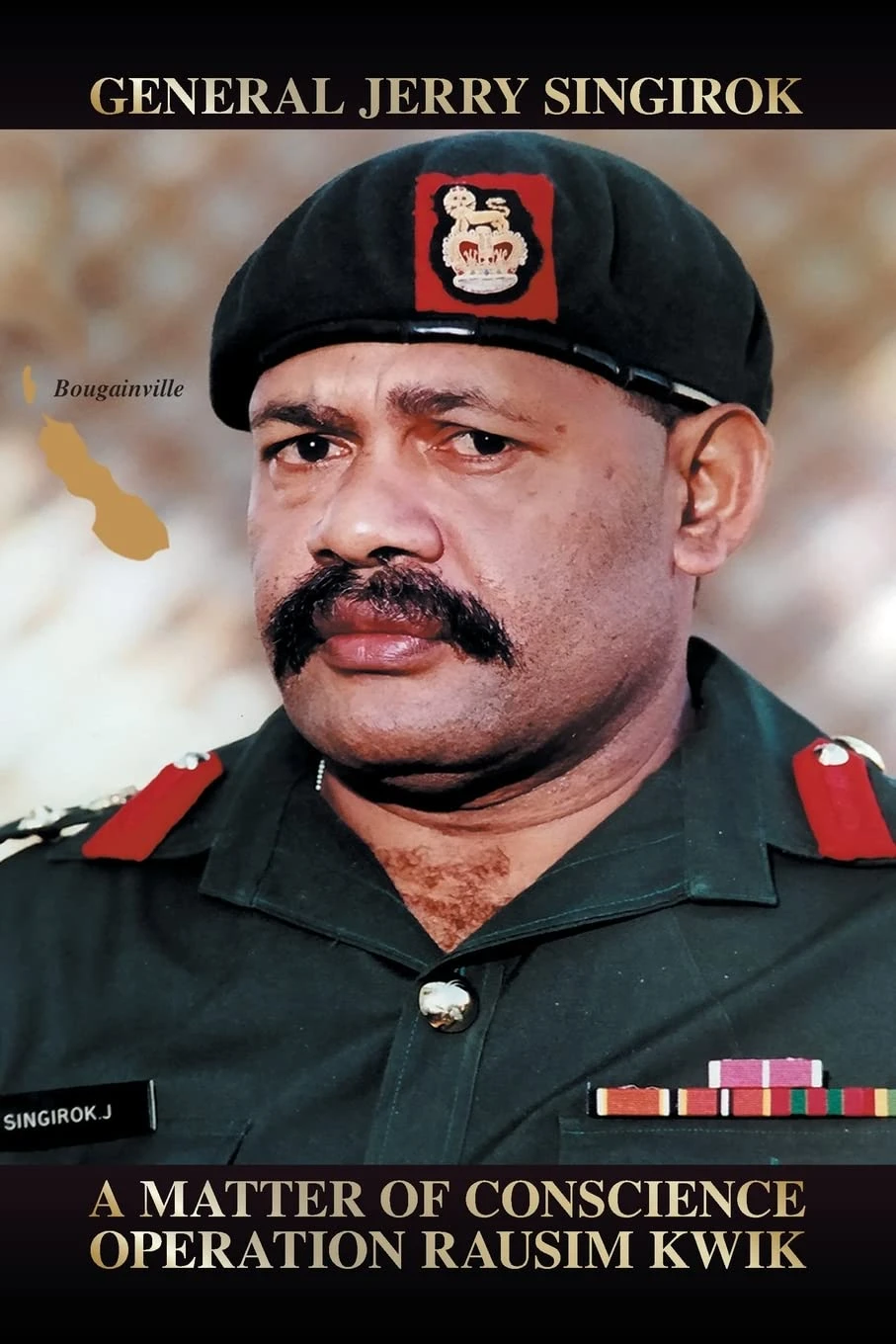
What the book covers
The title has two parts. “Operation Rausim Kwik” names the action Singirok took in 1997. “Rausim kwik” is Tok Pisin, roughly “remove quickly.” The notice describes the book as an account written from the perspective of the former Army commander, and as a “no holds barred” telling of a mutiny.
According to the notice, the book covers:
- The events leading up to the Sandline crisis and what happened when Singirok defied the prime minister’s orders.
- The inquiries, dismissals and charges that followed.
- What shaped him as a youth and as a young man.
- His career as a professional soldier in the Papua New Guinea Defence Force.
- How he rebuilt his life after the Sandline Affair.
That is a wide range for one book. It explains the length, and it means the story is not confined to a single week in 1997.
The Sandline Affair as the book tells it
The notice puts the background briefly. The government of then prime minister Sir Julius Chan was intent on winning the civil war on Bougainville. It engaged Sandline mercenaries to help. Singirok, as defended force commander, defied Chan’s orders and acted to stop them.
The notice says the mercenaries were “stopped in their tracks,” and that this potentially saved thousands of lives. That is the framing of the book’s promoter and of the author’s own side. Readers should treat it as the account being offered, and weigh it against other records of the period.
Whatever view a reader takes, the event raised a hard question about civil-military relations. When a government issues an order to its armed forces, and the commander believes the order is wrong, what should he do? The book’s title points to Singirok’s answer: he acted on conscience.

Singirok had just been sacked and everyone was jumpy when his bodyguard, Corporal Allen, pulled a pistol on a soldier who arrived unexpectedly at Murray Barracks. The soldier said he just wanted food. Photo: Andrew Meares.
What happened after 1997
The sequence that followed, as the notice sets it out, is long and has several reversals:
- Singirok was dismissed after defying Chan’s orders and faced a number of inquiries.
- One of those inquiries reinstated him in 1998.
- The government, dissatisfied, called another inquiry. In 2000 he was dismissed again, facing a number of charges including sedition.
- In March 2004 he was cleared of all charges except sedition, and his military career was over.
The dates cover seven years, from the 1997 confrontation to the 2004 outcome. A reader who wants the wider setting for these events can use our Papua New Guinea history timeline, which places the period within the longer story of the country from colonial administration to independence and after.
A memoir that looks back critically
A reviewer quoted in the post notes that twenty years on from the abrupt end of his military career, Singirok has had much time to think about the past. The same reviewer sees a strength of the manuscript in how far he stands back and reflects, often quite critically, on his own decisions. He also reflects more broadly on politics, leadership, corruption, faith, family and other parts of public and personal life in PNG.
This matters for the kind of book it is. A memoir that only defends its author is useful as testimony but limited as history. A memoir in which the author questions his own choices gives readers more to work with, because it shows what he thinks the stakes were and where he now sees his own judgement as open to doubt. Whether Singirok does this in each chapter is something only a reader of the full book can say. The review describes it as a defining feature of the manuscript.
The notice also calls the book “well written, revelatory and a real page-turner.” That is the promoter’s opinion, and it is fair to read it as such.

Singirok briefs his troops as the crisis unfolds.
How to read a participant’s account
Anyone reading a memoir by a person at the centre of a disputed event should keep a few habits in mind. They apply to Singirok’s book as to any other. PAPUANIUGINI.ORG takes no side in political disputes, and the book is best read as one important voice among several.
- Separate what he did from why he says he did it. Actions can be checked against inquiry records and news reports from the time. Motives and private conversations usually rest on the author’s word alone.
- Note where others’ motives are described. When the author explains what the prime minister or other officials intended, that is his interpretation. Look for how those people described their own decisions.
- Check dates and sequence. With dismissals, reinstatement, a second inquiry and charges spread over years, it is easy to blur which event came first. Writing out your own timeline helps.
- Compare with other accounts. Official inquiry findings, contemporary newspaper coverage and academic writing on the Bougainville conflict give a fuller picture than any single memoir can.
- Watch for the author’s own doubts. Passages where he questions his own judgement are often the most informative.
Singirok’s views on Australia
The notice also mentions Singirok’s more recent public positions, as of its 2022 posting. He has been outspoken against Australian intervention in the Pacific, particularly the deployment of forces to the Solomon Islands. According to the notice he has accused Australia of imperialism and suggested that Papua New Guinea risks becoming a failed state.
These are his claims and opinions, reported as such. They are not established facts, and other people in PNG and Australia hold different views. They do show that the questions raised by the Sandline Affair, about foreign involvement, the role of the military and the strength of national institutions, remain live in his thinking.
Who the book may suit
Based on the notice, the book is likely to interest several kinds of reader:
- Students and teachers studying PNG’s modern political history, who want a first-hand account to set beside secondary sources.
- Readers interested in the Bougainville conflict and how decisions about it were made at the top of government and the defended force.
- Papua New Guineans overseas who want to understand a defining episode in their country’s recent past.
- Researchers who want the perspective of a former commander, read critically alongside official records.
At 636 pages, it is a substantial commitment. Readers may want to start with the chapters on 1997 and then work backward and forward.
Book details and how to get a copy
- Title: A Matter of Conscience: Operation Rausim Kwik
- Author: Major-General Jerry Singirok
- Publisher: Partridge Publishing, Singapore
- Published: February 2022
- Length: 636 pages
When the notice was posted in April 2022, Amazon listed the hardcover at $100 and the paperback at $72.95. Prices change, so check the current listing before you buy.
The notice also said that Rae Smart was assisting Singirok pro boon, describing the book as “more than a book to have on your shelf” and “a real lesson in life.” She arranged for a limited number of first editions in Australia and invited interested readers to email her at raesmart@me.com. That arrangement dates from 2022, so availability may have changed.
The Amazon link below is an affiliate link. If you buy through it, this site may earn a small commission at no extra cost to you.
Find A Matter of Conscience: Operation Rausim Kwik by Jerry Singirok on Amazon.

