Coffee is grown by hundreds of thousands of Papua New Guineans, yet the coffee industry in Papua New Guinea is often described as if the grower were only the first step in someone else’s business. A growing number of local farmers, cooperatives and small entrepreneurs are changing that by processing their own coffee, buying from neighbours, or selling under their own name. This article sets out how the chain works, where growers can take more of it, and what stands in the way.
Where a smallholder’s coffee stops being theirs
In outline, the chain for most highland arabica starts in a family garden. The household picks ripe cherry, pulps it, ferments and washes it, and dries the beans in their parchment skin. Each of those steps affects quality, and quality sets the price the grower is offered.
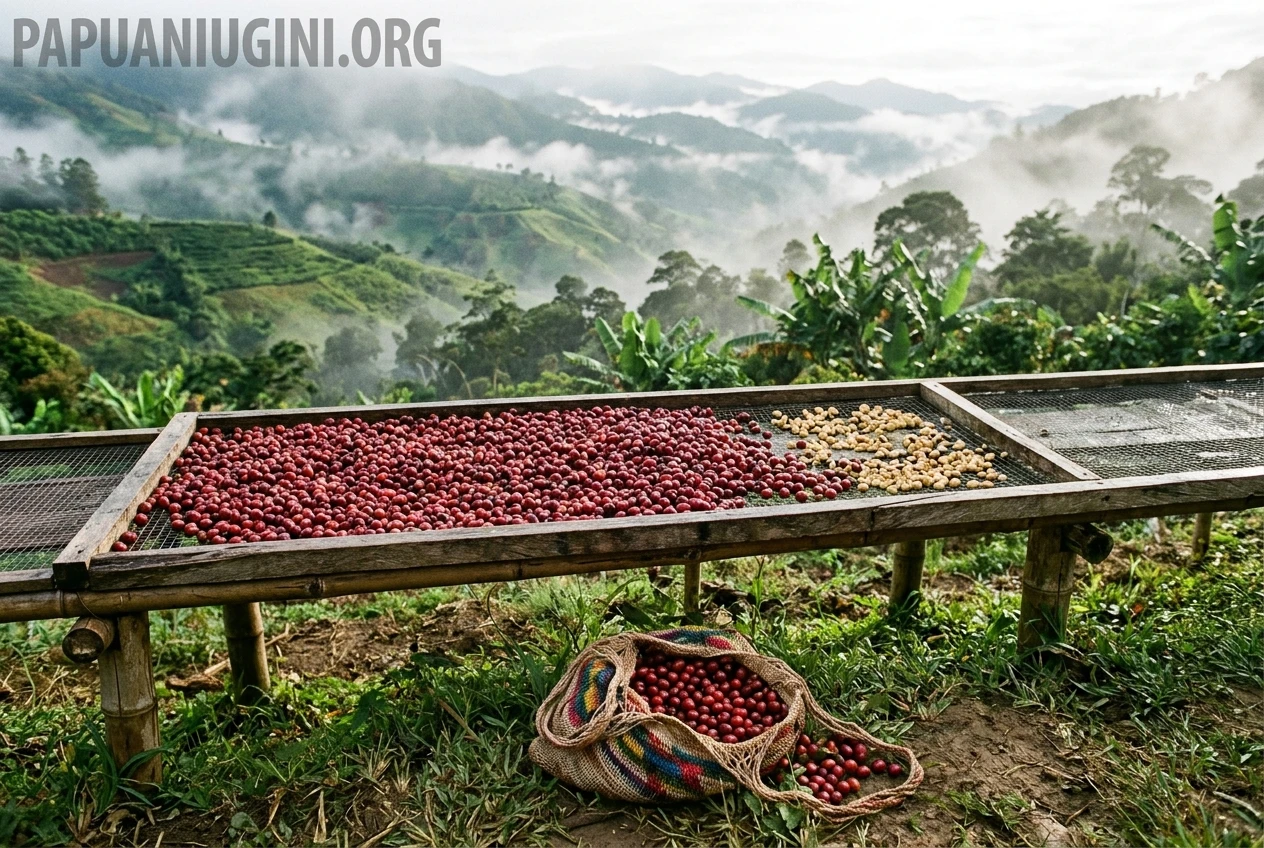
From there the coffee usually passes through a series of hands:
- A roadside or village buyer, or a small trader, who collects parchment or sometimes cherry from many gardens.
- A processor with a dry mill, where the parchment is hulled, sorted and graded into green bean.
- A licensed exporter, who ships the green bean to an overseas buyer or roaster.
Ownership of the coffee changes at the first sale. Many growers sell as soon as the coffee is dry enough, or earlier, because the household needs cash for school fees, church contributions, bride price obligations or store goods. A grower who sells cherry or poorly dried parchment to the first buyer who arrives has little say in the price, and nothing of the finished product carries their name.
This is why so little of the final value stays in the village. The grower carries the weather risk and most of the labour. The buyer, processor and exporter each add a cost or a margin, and each needs capital the grower may not have.
Three ways local growers are taking more of the chain
Taking more of the chain does not mean doing everything at once. It usually means taking over one more step, and the three most practical steps are processing, buying and branding.
Processing better
The cheapest move is to improve the step the household already controls. Careful picking of ripe cherry only, pulping on the day of picking, clean water for washing and slow, even drying on raised beds all raise the quality of parchment. Buyers pay for the coffee they can grade well, and clean, evenly dried parchment is easier to sell to a buyer who competes for it.

Groups can go further by pooling money for a shared wet mill or a drying facility, so that a village delivers a consistent lot rather than dozens of small, mixed ones. A larger lot of consistent quality gives the group something to negotiate with. Before buying equipment, talk to the Coffee Industry Corporation (CIC), the national industry body, about extension advice and which processing standards buyers will expect.
Buying from neighbours
A local buyer collects coffee from several households and sells it on in larger volumes. This is how many local entrepreneurs enter the trade without owning a plantation. It needs working capital to pay growers promptly, scales you can show are accurate, transport to the mill or the road, and somewhere dry to store coffee.
Buying also carries risk. If you pay growers before you have sold the coffee and the buyer you deliver to is late or pays less than you expected, you carry the loss. Check whether your activity needs registration or a licence with the regulator before you start, and keep written records of every purchase.
Selling under your own label
Selling roasted or packed coffee under a family, village or cooperative name is the most visible way to own more of the chain, and the hardest to do well. It needs consistent quality, a roaster, packaging, a name that can be registered, and a way to reach customers. The customers may be Port Moresby cafes, local shops, visitors, or Papua New Guineans overseas who want coffee from home.

A label works only if every bag tastes the same as the last. A grower who starts with a small, reliable product and sells it in one town will learn more than one who orders thousands of printed bags. Our guide to the digital tools for small business in Papua New Guinea covers practical ways to take orders and keep records without a shop.
What it takes to export
Exporting is the step where most local businesses stop, because it combines licensing, quality control and paperwork. The details change, so treat what follows as a checklist of questions to put to the official bodies, not as a ruling.
Start with the CIC, which regulates the industry. Ask it directly:
- Whether you need an exporter’s licence, and what the conditions and fees are today.
- Which quality standards and grading rules apply to green bean for export, and how coffee is inspected before it ships.
- What records and reports exporters must keep.
- Whether there are rules on who you may buy from and at what stage of processing.
Beyond the coffee regulator, an exporting business usually has to deal with other government agencies. Registering the business name or company is handled by the Investment Promotion Authority. Tax obligations go through the Internal Revenue Commission. Customs requirements apply when goods leave the country. Ask each agency for its current requirements in writing, and keep the answers.
There is also the buyer’s side. An overseas buyer will specify quality, volume, delivery dates and payment terms, and the importing country may have its own requirements. A first contract is far more likely to succeed when it is small enough to deliver on time. Be wary of any buyer or agent who asks for money up front before a contract is verified, and check them as carefully as you would check a recruitment agency, a point we make in our guide on how to check a PNG mining recruitment agency that applies equally to export middlemen.
Many local businesses reach overseas markets by selling green bean through an established licensed exporter first, and then taking on more of the export work as their volumes and records improve. That keeps the first deals small and the learning affordable.
Money and mobile banking
Whoever buys coffee needs to pay growers, and whoever grows it needs a safe place to keep the income. Where a buyer pays in cash at the roadside, the grower carries that cash home and has no record of the sale. Where payment goes to an account or a mobile wallet, there is a record that can later support a loan application or a business plan.
For a grower moving into processing or buying, a record of income matters. A bank or microfinance lender asks how much you earn, how regularly, and whether you have saved. A notebook of dated sales, plus deposits into an account, answers those questions better than memory does.
Digital ID and access to banking are part of this. Our report on the DICT and CEFI agreement on digital ID and banking access explains the effort to link identity registration to financial services. Growers in coffee provinces should ask their district or provincial offices and their bank what identification they will need and when it will be available locally.
On borrowing, ask any lender for the full cost in writing before you sign: the interest rate, fees, the repayment schedule and what happens if a harvest fails. A coffee income arrives seasonally, so a repayment schedule that demands the same amount every fortnight may not fit.
Roads, freight and electricity
Highland coffee has to travel to a port, and the road is the longest part of the trip. The Highlands Highway links the highlands to the port at Lae, and coffee from other provinces moves through other ports and by other routes, including by air and sea. Each leg adds freight cost, delay and risk of damage, and these costs are carried by the person who owns the coffee at that moment. A grower who sells at the village gate does not pay them, but also does not receive the higher price a buyer in town pays.

Wet coffee left waiting for a truck spoils. Dry parchment kept in damp storage develops mould. Electricity matters for dry mills, hullers and roasters, and a business that depends on mains power or fuel for a generator must budget for outages and fuel prices.
Maintenance is the quieter part of the problem. A road that was sealed and then left without drain clearing or pothole repair deteriorates quickly. Our article on who looks after PNG’s new roads, bridges and clinics after the ribbon is cut looks at who is responsible, and a coffee group can use it to ask the right questions of provincial and district officers. Groups that organise their own deliveries, for example by sharing a truck on a fixed day, spread the cost across more bags.
Stories to look for
The stories this series will publish are about farmers, cooperatives, buyers, roasters and exporters from coffee provinces. Each one will be built on what the person or business tells us directly and what we can confirm independently.
That means several things in practice:
- We ask the person for permission before publishing their story and their photos.
- We credit anyone who sends us a story or photographs.
- We check claims about volumes, ownership, licences and export sales against official or published sources where they exist, and say so when we could not confirm something.
- We do not publish quotations we cannot attribute.
- We separate what a business says about itself from what we have confirmed.
Named profiles will follow as each one is verified, in the same way that we have documented the history of Arau in our profile of Muriel Larner, who owned Arau Coffee Plantation in the Eastern Highlands. That piece covers the life; this series covers coffee businesses operating now.
What a young grower in a coffee province can do this season
The main picking period in most highland areas is over by November, so this is a good time to prepare for the next harvest. Timing varies by altitude and province, so check the local calendar with a CIC extension officer. These are steps in order, and each one takes a few weeks at most.
- Keep a record from today. Write down the number of trees, the bags or kilograms you sold, the date, the buyer and the price. Without this, you cannot tell which buyer paid best or whether your coffee is improving.
- Visit the nearest CIC office or extension officer. Ask about pruning, shade, pest and disease control, and processing standards. Ask which buyers and mills in your area are registered.
- Fix one step of processing before the next harvest. Build raised drying beds, arrange clean water for washing, or agree with neighbours to pulp on the day of picking. Choose the step that costs least and affects quality most.
- Talk to other growers. Compare the prices different buyers offered last season. Consider whether a group of five or ten households could sell together, with one person responsible for delivery and one for the accounts.
- Open an account or mobile wallet if you do not have one. Ask what identification is needed, and move your coffee income into it rather than keeping it in cash.
- Ask a licensed buyer or exporter what they look for. Request a sample grading explanation, and ask what quality, volume and delivery dates they require. This tells you whether to aim for buying, processing or a label next.
- Register a business name only when you have something to sell. Then contact the Investment Promotion Authority and the Internal Revenue Commission to ask what registration and tax obligations apply.
Young growers who are comfortable online can also use it to find out about buyers and standards, keeping data costs in mind. Our guide to digital skills for getting a job in Papua New Guinea when your data is limited has practical advice on doing that cheaply.
Know a coffee farmer, cooperative or local exporter in your province whose story should be told? Send it to us with their permission and any photos, and we will verify it and credit you. Join the newsletter to read these stories as they are published.