

Funding decides whether many Grade 12 leavers and current students in Papua New Guinea can start or finish a course. Information about scholarships for PNG students is also scattered across websites, Facebook pages, notice boards and WhatsApp groups, and not all of it is true. This guide gives you a route that stays useful after individual scholarships open and close: where to look, how to check an offer is genuine, how to prepare your application, and how to submit it when internet and transport are unreliable.
It does not list individual scholarships with amounts and deadlines, because those change every round. Your job is to find the current details on the official source, and the sections below show you how.
Three kinds of study funding
Most funding available to PNG students falls into one of three groups. Knowing which group an offer belongs to tells you who to contact and what to expect.
Government funding inside PNG. This includes national assistance for tertiary students, which is managed through the Department of Higher Education, Research, Science and Technology, and support from some provincial governments and district offices. Eligibility rules, the amount covered and the way you apply are set by the government each year, so always read the current notice.
Overseas scholarships. These are awards from foreign governments and international bodies for study in another country, mostly at postgraduate level, though some cover undergraduate study. They usually require you to return to PNG after your studies, and they take the longest to prepare for.
Employer-linked and institutional support. Some companies, church bodies, foundations and universities offer sponsorship, bursaries or fee reductions. The conditions often include a work commitment after graduation, or a place in the sponsor’s own recruitment pool. Read what you would owe in return before you accept.
Before you apply to any of them, decide what you want to study and where. Funding follows a course and an institution, and many awards only cover approved programs. Our guide to choosing a university in Papua New Guinea will help you compare options so your scholarship applications match a realistic plan.
Where to look for domestic scholarships and sponsorship in PNG
Start with the offices that pay or administer the money. A message forwarded through three phones is the weakest source you can use.
- The Department of Higher Education, Research, Science and Technology. Look for its official announcements on tertiary assistance, including who qualifies and how applications are lodged.
- Your institution’s student services or financial aid office. If you have already been offered a place, the university or college can tell you which funding applies to your program and whether it has its own bursaries.
- Your provincial education division and provincial administration. Ask what support exists for students from your province and who handles the applications. Policies differ between provinces and can change with each budget.
- Your district office and your local member’s office. Some districts assist students with fees. Ask in person what the process is, and whether it is written down.
- Employers and resource companies. Check the company’s official careers or community pages, and the landowner or community organisation attached to a project. Our article on how to apply for a mining job in Papua New Guinea explains how to find official recruitment channels, and the same habit applies to company scholarships.
- Churches and church education agencies. Many agencies support students, particularly those who attend church schools or colleges. Ask your pastor or church education secretary which office handles the applications.
Confirm the details before you plan around them
For every domestic opportunity, write down the answers to six questions before you spend time on it:
- Who is offering it, and who is the named contact?
- Which courses and institutions does it cover?
- Does it pay fees only, or living costs and books too?
- What is the closing date, and where must the application be lodged?
- What do you owe afterwards, such as bonded service or repayment?
- Is the information on an official page, notice or letterhead that you can check yourself?
If you cannot answer the last question, treat the offer as unconfirmed.
Overseas scholarships PNG students commonly apply for
Several foreign governments run well-known awards that PNG citizens can apply for. The details below describe what each commonly asks of applicants. Each program updates its rules every round, so read the current guidelines on the official website before you decide.
Australia Awards. The Australian Government funds study in Australian institutions for applicants from PNG and other Pacific countries. Applicants are generally expected to show their study will contribute to development in PNG, and to return home after the award. Read the current eligibility and the list of priority fields on the official Australia Awards website.
New Zealand Scholarships. The New Zealand Government offers awards for students from developing countries, including Pacific nations. These awards are commonly aimed at people who will apply what they learn in their home country. The official New Zealand government scholarship pages list the current eligible courses and the process.
Chevening Scholarships. This is the UK Government’s international scholarship program for one-year master’s study. It generally expects applicants to have relevant work experience, to show leadership potential and to return to their home country afterwards. The application is online through the official Chevening site.
Commonwealth Scholarships. Commonwealth countries can nominate candidates for study in other Commonwealth countries, usually at master’s or doctoral level. For many applicants the route runs through a national nominating body, so check the current official guidance for how PNG applicants apply.
University-specific and other government awards. Individual universities overseas, and governments such as those of China and Japan, offer scholarships that open to international students. Each has its own language, field and academic requirements. Read the official page for the program and the university’s own international admissions page.
What overseas awards usually ask of you
Across these programs, applicants are commonly asked for:
- Academic transcripts and certificates, often with certified copies
- A completed online application form
- A personal statement or essay
- Two or more referee reports
- Proof of English language ability, where the course is taught in English and your previous study was not
- A valid passport
- A plan for how you will use your qualification when you return to PNG
Some awards also need an offer of admission from a university before you can apply, while others let you apply for the scholarship and the course at the same time. The order matters, so check it first. If a course needs an English test, book it early, because test centres may be only in major towns.
How to tell a real scholarship from a scam
Students searching for funding are a target for fraud. Anyone can create a convincing Facebook page or a certificate with an official-looking logo. Check these things before you send any document or any money.

Warning signs
- You are asked to pay. A fee to apply, to be shortlisted, to “release” the award or to cover “processing” or “visa clearance” is a major red flag. The government-funded awards named above do not work this way, and if a message claims otherwise, check the official website.
- You are told you won something you never applied for. Genuine awards require an application.
- The contact uses a free email address or a personal phone number. An embassy, university or government department will normally write from an official email domain.
- Selection is guaranteed. Real scholarships are competitive, and no honest agent can promise a place.
- The pressure is urgent. “Reply in 24 hours or lose your place” is designed to stop you from checking.
- They ask for bank details, PINs or passwords. No scholarship needs these at the application stage.
- The only source is a forwarded image or a post that cannot be traced. If you cannot find the offer on the official website, treat it as unconfirmed.
How to check
- Go to the official website yourself. Type the address of the government agency, university or program into your browser. Do not use a link from a message.
- Look for the same offer there. If the scholarship is real, it will be described on the official site with the same name, requirements and dates.
- Contact the organisation directly. Use the phone number or email listed on the official website, not the one in the message.
- Ask a person who can check. Your school’s career or guidance teacher, the university’s student services office or a relevant government department can often confirm whether an offer exists.
- Search the name with the word “scam”. Reports from other students can help, though a lack of reports proves nothing.
- Send documents only through the official application portal or the address named in the guidelines. Hold back copies of your passport and bank information until you have confirmed who will receive them.
If you suspect a scam, do not pay. Stop replying, tell your school or family so others are warned, and report the page on the platform where you saw it.
Build your application
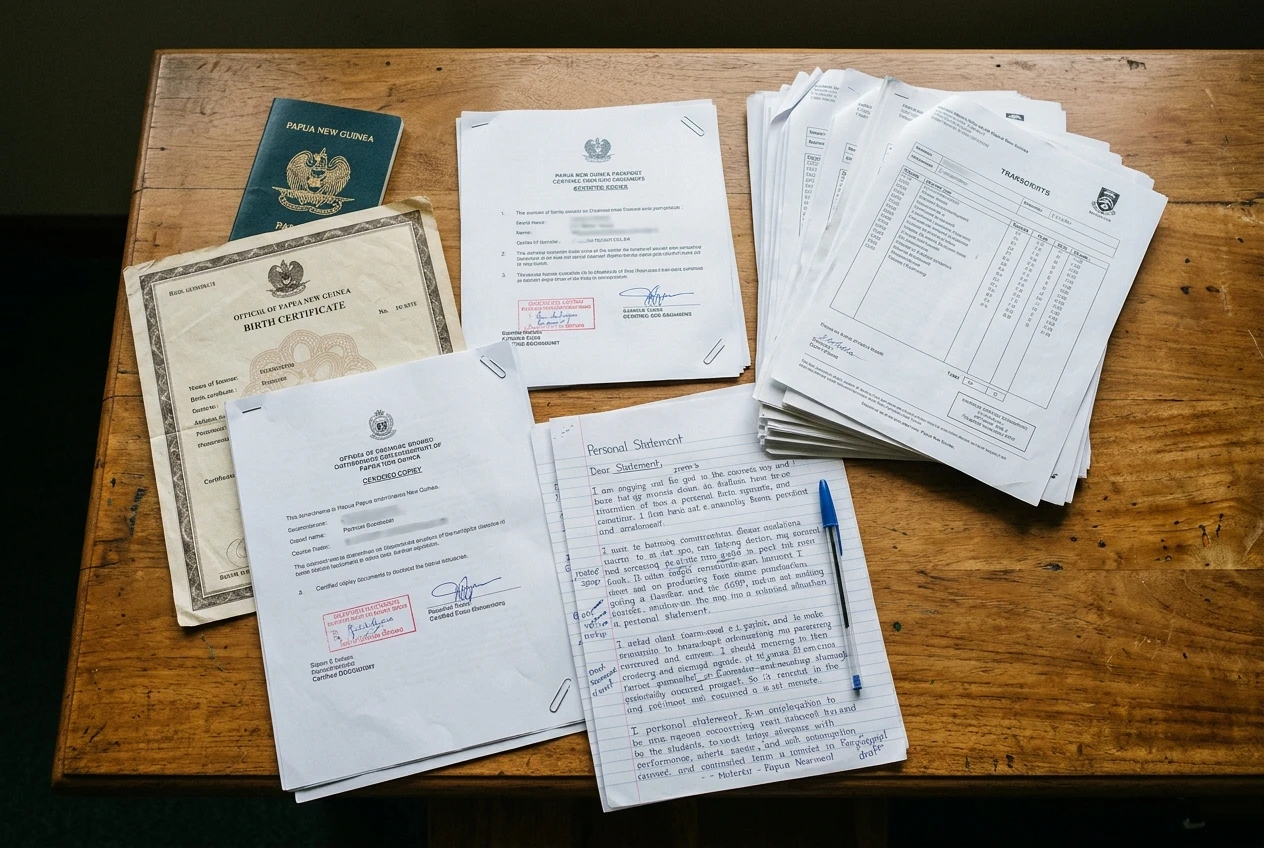
A strong application is complete, accurate and in your own words. Start gathering the material before the call for applications opens.
Documents
Collect these early and keep the originals safe:
- Birth certificate or other identity proof, and your national ID or passport if you have one
- Grade 12 or equivalent certificates and results
- University or college transcripts, if you are already studying
- A current CV listing study, work, volunteering and responsibilities
- Certified copies, where required, with the certificate’s name, signature and date clearly visible
- Proof of English ability, where requested
- Any letter of offer or admission from a university
Passports and official transcripts can take weeks to obtain. If you do not have a passport and an overseas award may be in your future, begin the passport process well before any deadline.
Referees
Choose people who know your work: a teacher, lecturer, employer, church or community leader who supervised you. Ask politely and early, at least several weeks before the closing date. Give each referee:
- The scholarship name and the closing date
- A copy of your CV
- A short summary of what you are applying for and why
- Clear instructions on where and how to send the reference
Thank them, and tell them the outcome afterwards.
A personal statement that sounds like you
Selectors read many statements. The ones that stand out are specific. Follow the question that has been asked, and answer it directly.
- Say what you want to study and why that course suits you.
- Give one or two concrete examples of what you have done, such as a school project, a job, volunteering or helping in your community.
- Explain what you plan to do with the qualification, and how it will help your family, community or the country.
- Use plain English and your own sentences. Do not copy a sample statement from the internet or paste text from a chatbot without rewriting it in your own words, since selectors can often recognise generic writing.
- Ask a teacher or someone you trust to read it for clarity and spelling, then check the word limit.
Write about things that actually happened to you. If a sentence in your draft is not true, remove it.
Applying with weak internet, limited power and long distances to town
Many applications are online, but not every student lives where connections are steady. Planning around that is part of the application.

Prepare offline.
- Write your personal statement in a notes app or word processor on your phone or a borrowed computer, then paste it into the form on the day.
- Download the guidelines and application forms as PDFs when you have a signal, so you can read them later without data.
- Keep a list of every document you need and tick each one off.
Scan and store carefully.
- Photograph documents in good daylight, flat on a table, with all four corners visible.
- Save each as a PDF or JPG with a clear file name, such as “Grade12-Certificate”.
- Reduce file sizes if the portal has an upload limit, and check that each file still opens and is readable.
- Keep a second copy on a USB drive or memory card, and email the files to yourself.
Protect your power and data.
- Charge your phone and power bank fully before you travel to town or to an internet access point.
- Buy enough data in advance, since uploads use far more than browsing.
- Do not wait until the last day to submit. Slow connections, power cuts and portal congestion are most likely at deadline time.
Plan for distance.
- Combine errands into one trip: certifying copies, printing, collecting transcripts and uploading.
- Allow extra days for delays in transport such as flights, boats and PMV services, particularly in wet weather.
- Ask whether your school, church, library, provincial education office or a local business has internet that students can use, and ask someone you trust to help you upload if you need it.
Confirm that the application went through.
- Take a screenshot or save the confirmation email after you submit.
- If the process requires posted documents, keep the courier or post receipt and ask for a tracking number if one is available.
A simple tracker for deadlines, requirements and follow-ups

Applying to several scholarships at once is easier with one record. Use a notebook, a spreadsheet or a notes app, with one row per opportunity and these columns:
Column What to write Scholarship and provider The official name and who runs it Official website or office The address or contact you verified yourself Opening and closing dates Dates from the official source, plus your own earlier target date Eligibility check Whether you meet each requirement: yes, no or unsure Documents needed Each item, marked when ready Referees Names, date asked, date they confirmed, date they sent it Submitted Date and a note of where the confirmation is saved Follow-up date When the outcome is expected and when you will check Outcome and notes Result, feedback, and what to do next
Set your own deadline two weeks before the real one, and work to it. Review the tracker once a week. If an official page lists a closing date and another source gives a different one, use the official one and note the difference.
What to do if you are not selected
Most scholarship applications are unsuccessful, because there are far fewer awards than applicants. A rejection does not mean you were not good enough, and there are practical steps to take.
- Ask for feedback. Some programs give it, and a short polite email to the official contact is acceptable.
- Check whether you can reapply. Many programs allow a new application in a later round. Note the next opening date in your tracker.
- Strengthen your application. Gain relevant work or volunteer experience, improve your English or your grades, and ask your referees whether they can speak about new achievements.
- Look at the other funding types. If an overseas award did not work out, check domestic government support, provincial assistance, employer sponsorship and your institution’s own bursaries.
- Consider a staged plan. Starting at a PNG institution, working for a period or studying part-time can keep you moving while you prepare to apply again.
- Plan beyond graduation. Funding gets you into a course, and after that comes work. Our report on Opposition Leader Hon. James Nomane urging graduates to “build your own door” amid unemployment challenges is worth reading for what he said about graduate jobs and the options open to you after study.
Keep your documents, referees and personal statement ready, and update them each time. Your second application starts from a much better position than your first.
Join the PAPUANIUGINI.ORG newsletter to get our scholarship and student opportunity guides as we publish them, and tell us in the comments which scholarship you want explained next.

