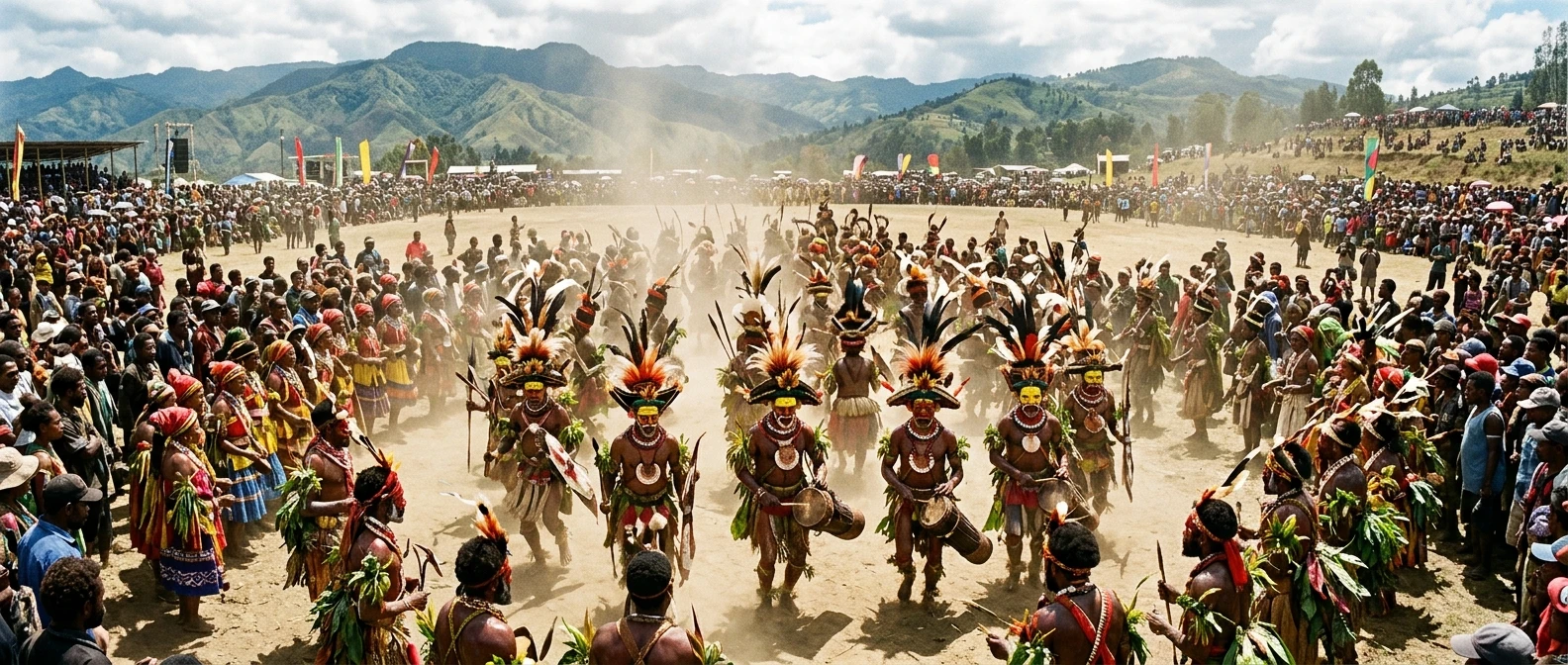
Papua New Guinea holds more cultural diversity in its mountains, valleys, and islands than almost anywhere else on earth, with over 800 languages and thousands of distinct clan groups each carrying their own songs, body decoration, dances, and stories. For most of the year, these traditions live inside villages, church grounds, and family compounds. A handful of times each year, they come out into the open at organised shows and ceremonies, and travelers who plan around the right dates can watch things that exist almost nowhere else on the planet.
Cultural festivals in Papua New Guinea are not staged performances built for tourists. They grew out of colonial-era agricultural shows and older intertribal gatherings, and they still function as genuine meeting points between groups who might otherwise rarely cross paths. A Huli wigman from the Southern Highlands and a Tolai dancer from East New Britain are not performing the same culture wearing different costumes. They are showing two entirely separate traditions, shaped by different land, different history, and different beliefs about ancestors and spirits. Knowing which festival is which, and what each one is actually built around, changes what a visitor sees when they get there.
This guide covers five festivals worth the trip, with enough on timing, location, and meaning to plan around rather than guess at.
Why Papua New Guinea’s Festivals Draw Travelers From Around the World
International photographers, anthropologists, and cultural travelers have been coming to PNG’s shows for decades, and the reason is straightforward: nowhere else brings this many distinct cultural groups into one place, in traditional dress, performing ceremonies that still carry meaning at home. A single show ground can hold dancers from fifty or more language groups, each wearing decoration specific to their own clan, singing songs that belong to their own ancestors.
For Papua New Guineans living overseas, these festivals also work as a point of connection back to home provinces and to traditions that may not be practiced daily in Port Moresby or in the diaspora. Watching a Highlands sing-sing or a mask ceremony from Rabaul is watching something that has been passed down through specific families, not something written for an audience.
The five festivals below differ in scale, region, and purpose. Some are large organised shows built for visitors as well as locals. Others are closed ceremonial events tied to the agricultural calendar of a single island group. Both kinds matter, and both reward a traveler who understands the difference before arriving.
The Goroka Show: The Highlands’ Biggest Gathering of Tribes
The Goroka Show, held in the Eastern Highlands provincial capital of Goroka, is the festival most international visitors picture when they imagine PNG’s “sing-sing” culture. It runs over a long weekend, typically in September, timed around PNG’s Independence Day period, and it draws tribal groups from across the Highlands region and beyond.
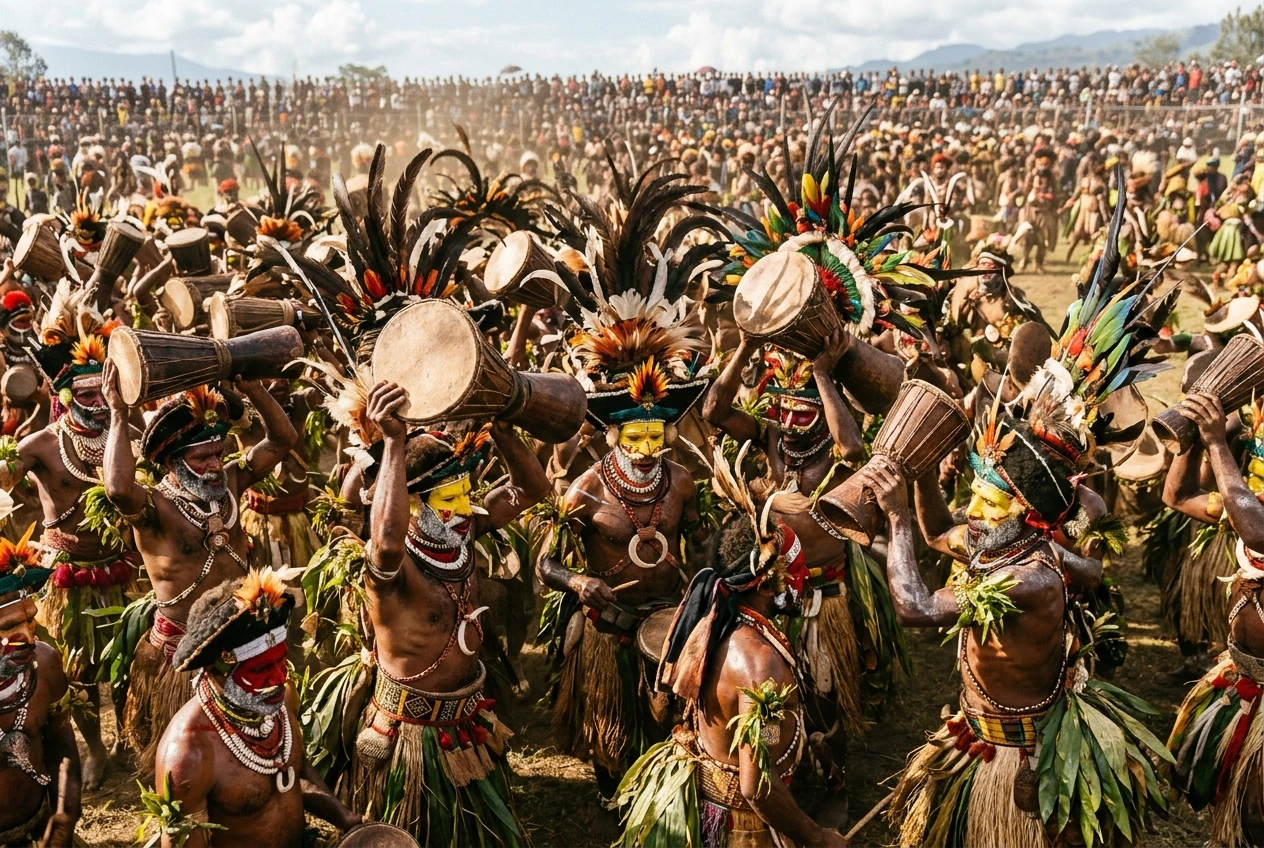
What sets Goroka apart is sheer scale and density. Dozens of groups, each representing a different clan or language community, gather on one show ground wearing bird-of-paradise plumes, shell decorations, and clay and ochre face paint specific to their own area. Groups compete informally for the most striking presentation, and the noise of overlapping chants and kundu drums across the field is part of the experience.
Goroka sits in the Eastern Highlands, reachable by domestic flight from Port Moresby, with accommodation available in town. Because it is one of the longest-running and best-organised shows in the country, it tends to be the easiest entry point for a first-time visitor to PNG’s Highlands festival circuit.
The Mount Hagen Cultural Show: A Rainbow of Traditional Dress
Mount Hagen, in the Western Highlands, holds its own cultural show in the same general period as Goroka, and the two are often paired on an itinerary since they fall close together on the calendar. Where Goroka is known for scale, Mount Hagen is known for the visual intensity of its traditional dress.

Groups attending the Hagen show come from across the Western Highlands and neighbouring provinces, and the costuming is built around elaborate headdresses, painted faces in red, yellow, and white, and feathers from birds of paradise, cockatoos, and parrots arranged in patterns specific to each clan. Photographers and documentary crews have followed this show for years specifically because of how much visual information is packed into a single dancer’s presentation: the headdress signals status and group identity, the paint pattern signals clan, and the specific combination of plumes can signal which bird species a particular highland area is known for.
Mount Hagen is accessible by domestic flight, and the show ground draws both performing groups and a large local audience from surrounding Highlands communities. Travelers planning to see both Goroka and Hagen in the same trip should confirm each year’s exact dates in advance, since timing can shift slightly from year to year.
The National Mask Festival: Rabaul’s Tribute to Ancestral Spirits
The National Mask Festival, held in Rabaul in East New Britain, is a different kind of event entirely, and it comes from a different part of the country. Rather than Highlands clans and bird-of-paradise plumage, this festival centres on the Tolai and Baining people’s mask traditions, including the Baining fire dance and the Tolai Tubuan, a masked figure tied to secret society initiation and ancestral spirit belief.
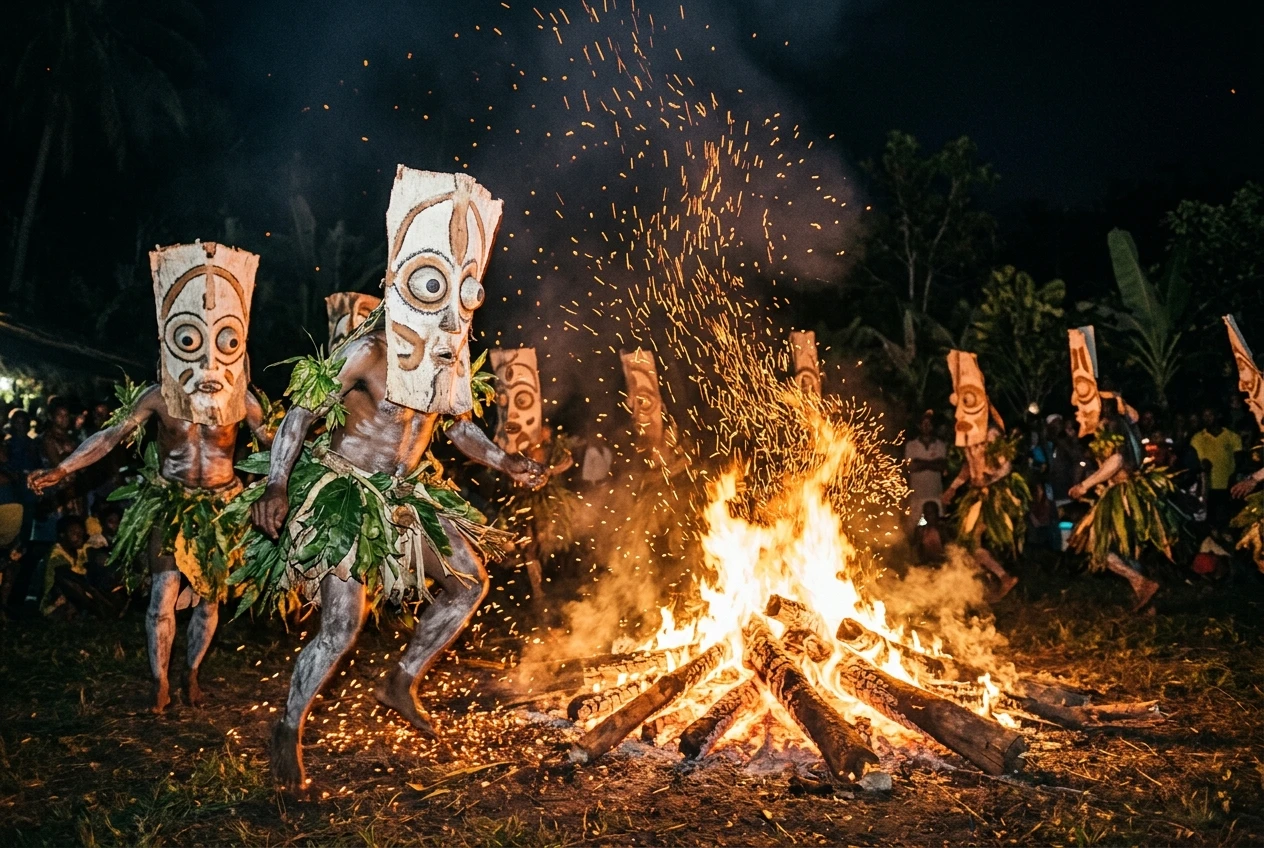
The festival typically runs in mid-year, and it is built specifically around the idea of spirits returning, briefly, in the form of masked dancers. The Baining fire dance, performed at night around a bonfire by dancers wearing tall bark-cloth masks, is one of the more striking ceremonial performances still regularly presented in PNG, and it is tied to practices around birth, death, and the passage between the world of the living and the world of ancestors. The Tubuan, by contrast, belongs to a men’s secret society and carries restrictions around who can approach, photograph, or handle it, which visitors should respect strictly.
Rabaul sits in East New Britain, reachable by air via Tokuba Airport near Kokopo, with Rabaul itself still recovering its full town infrastructure following past volcanic activity in the area. This festival rewards visitors who come with some prior reading on Tolai and Baining cosmology, since the masks mean far more than their visual spectacle suggests.
The Enga Cultural Show: Warriors, Wigmen, and Mountain Traditions
Enga Province, one of the more remote and mountainous Highlands provinces, holds its own cultural show that tends to attract fewer international visitors than Goroka or Hagen, which is part of its appeal for travelers who want something less built around tourism. The Enga show brings together clans known for warrior traditions, elaborate wig-making, and some of the most physically demanding traditional dance styles in the Highlands.
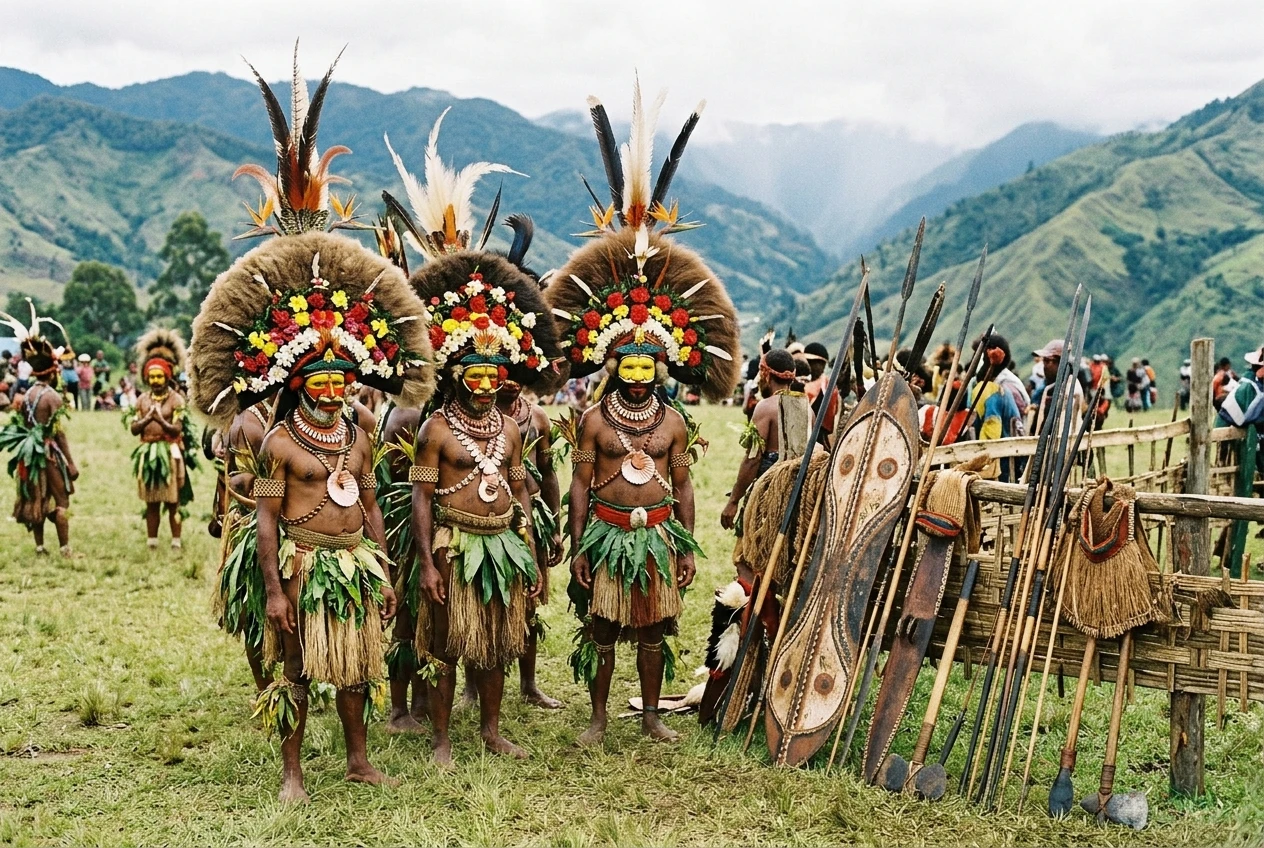
Engan wigmen are known specifically for constructing large ceremonial wigs from human hair, grown and shaped over months, decorated with everlasting flowers and feathers. The show ground display of these wigs, alongside traditional battle dress and weaponry carried for ceremonial rather than combat purposes, gives a direct view into a warrior culture that shaped how Enga clans organised themselves for generations before and alongside colonial contact.
Enga’s provincial capital, Wabag, sits at a higher altitude than Goroka or Hagen, and travel into the province can be slower and less developed than the two larger Highlands shows. Travelers who make the trip should expect a smaller, more locally oriented event, but one where the traditions on display are just as rich and considerably less photographed.
The Milamala Festival: Trobriand Islands’ Harvest Celebration
The Milamala festival, held in the Trobriand Islands off the coast of Milne Bay Province, is unlike any of the four Highlands and island festivals above. It is a harvest celebration tied to the yam cycle, held after the yam harvest is gathered, and it is historically associated with open courtship customs, including traditional dances that are frank and public in a way that sets Trobriand culture apart from much of the rest of PNG.
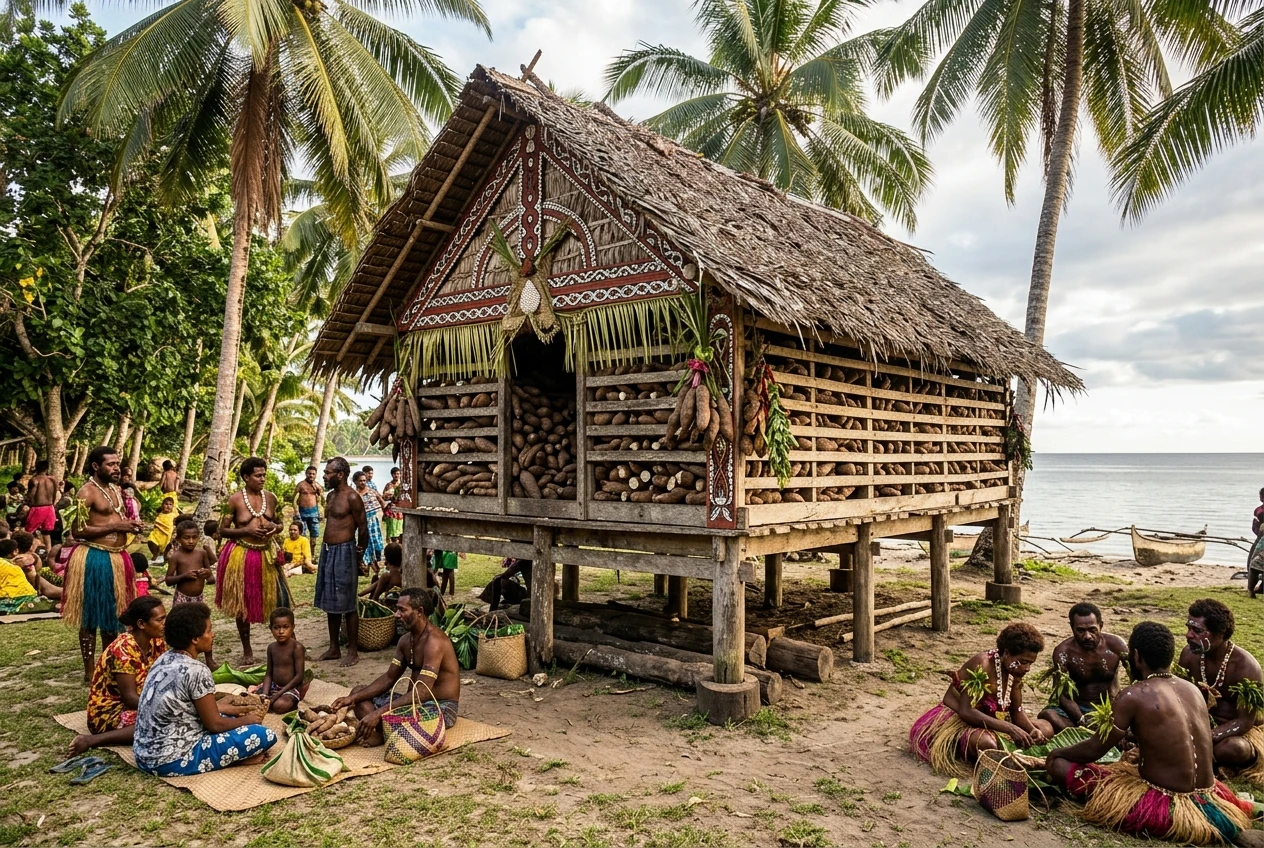
The Trobriand Islands were studied extensively by early twentieth-century anthropologists precisely because of customs like Milamala, and the islands retain a matrilineal clan structure where land and status pass through the mother’s line, a system distinct from most of mainland PNG. The festival itself centres on yam house displays, where the size and decoration of a household’s yam harvest is a public marker of status and productivity, alongside communal dancing that marks the end of the agricultural year.
Reaching the Trobriand Islands requires a flight to Kiriwina Island via Alotau in Milne Bay Province, followed by onward local transport, and the islands have limited accommodation infrastructure compared to the Highlands show towns. Because Milamala follows the yam harvest rather than a fixed calendar date, travelers should confirm timing directly with island contacts or tour operators closer to the date of travel, since the exact period shifts from year to year with the harvest itself.
Planning Your Visit: Timing, Access, and Respecting Local Customs
A few practical points apply across all five festivals. The two biggest Highlands shows, Goroka and Mount Hagen, generally fall within weeks of each other around PNG’s Independence Day period in September, which makes them the easiest pair to combine on a single trip. The Rabaul mask festival falls earlier in the year, Enga’s show on its own separate Highlands schedule, and Milamala follows the yam harvest rather than a fixed date. Confirming current dates directly with the relevant provincial tourism office or a PNG-based tour operator before booking flights is worth the extra step, since show dates can move from year to year.
Domestic flights connect Port Moresby to Goroka, Mount Hagen, Kokopo (for Rabaul), Wabag or nearby Highlands towns (for Enga), and Alotau (for onward travel to the Trobriands). Highlands roads between towns can be slow and are not always the preferred route for visitors unfamiliar with the region, so flying between show towns is usually the more practical choice.
Respect for custom matters more at these events than at an ordinary tourist attraction. Some ceremonial objects, particularly masks tied to secret societies like the Tolai Tubuan, carry restrictions on who may approach or photograph them closely, and a visitor should always ask before assuming a performance or object is open to general photography. Dress modestly, follow the lead of local guides on where visitors are welcome to stand, and understand that for the performers themselves, these events are not costume displays but living extensions of family and clan identity.
If you have attended one of these festivals yourself, or you have photographs and stories from your own province’s cultural show, PAPUANIUGINI.ORG welcomes verified community submissions to feature in future travel and culture coverage.