

Searching for the best courier services in Port Moresby usually ends in a list of company names with no way to tell which one suits your parcel. A courier that is quick for a document across town can be slow for a box going to a province, and one that suits an overseas sender may be a poor fit for a market seller in Gordons. This guide gives you the questions that decide whether a parcel arrives quickly, so you can apply them to any provider and repeat the check whenever services change.
Every price, cut-off time, route and tracking feature in this article is something you must confirm with the provider before you pay. Services and rates change, so this guide does not quote them. It tells you what to ask and where the answers matter.
What “quick delivery” means in Port Moresby
“Fast” covers three different jobs, and the courier that does one well may not do the others.
Same-city delivery moves a parcel between two addresses in the National Capital District, for example from a shop in Boroko to a customer in Waigani. The main variables are how late in the day the courier accepts bookings, how many drop-offs a rider or driver makes in one run, and whether the address can be found easily.
Nationwide delivery sends a parcel from Port Moresby to another PNG town or province. Speed here depends mostly on transport. Port Moresby has no road link to most of the country’s other major towns, so parcels travel by air or sea, and the schedule of that transport sets the pace. A courier can collect your parcel in an hour and still need days to move it.
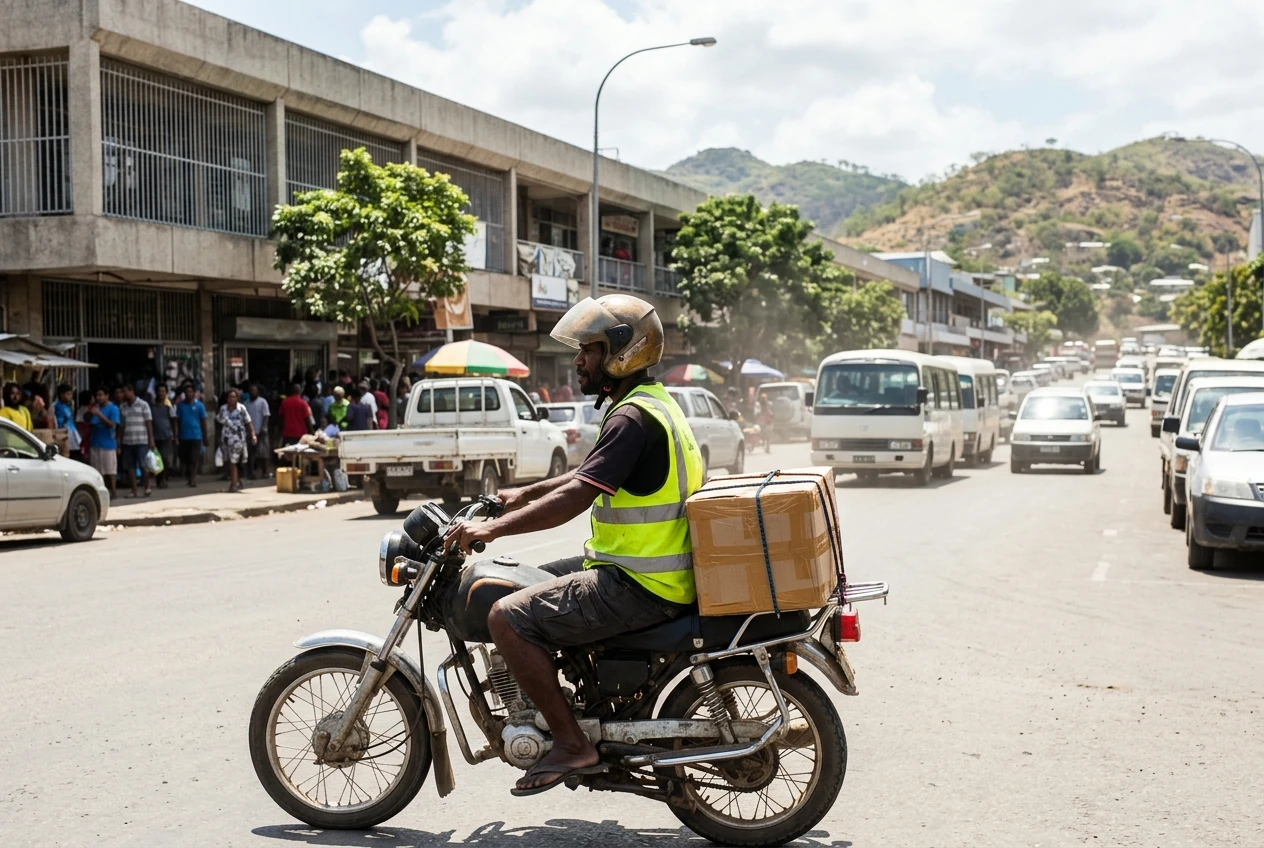
International delivery covers parcels coming into Port Moresby from overseas, or going out. Customs clearance, documentation and the carrier’s own handover to a local delivery partner all add time, and some of that time is outside the courier’s control.
Before you compare anyone, decide which of the three you need. Then ask each provider for their delivery time on that specific route, not a general claim of “fast delivery”.
The courier options to compare
Port Moresby customers generally choose between three kinds of provider. The right one depends on your route and your parcel.
PNG Post
PNG Post is the national postal operator, and it also offers courier-type services. It is easy to confuse with the Post-Courier, which is a newspaper. The Post-Courier reports the news and does not deliver parcels. If you search for “PNG Post Courier tracking” and land on newspaper pages, you are on the wrong site. Always reach PNG Post through its own official channels, and be cautious about any page or social media account that asks for payment on its behalf.
What PNG Post offers, which services it runs for which routes, and how it handles tracking should be confirmed with PNG Post directly. Ask which of its services applies to your parcel, because a standard postal item and a courier-style item may have different timeframes and different tracking.
International express carriers
Large international express companies are built for cross-border parcels. Their strength is usually a defined process from pickup to delivery, with tracking that follows the parcel across countries. If you are an overseas Papua New Guinean sending goods to a family member or business in the capital, or an online seller shipping out, this category is worth comparing. Ask whether the carrier delivers to the final address in Port Moresby itself or hands the parcel to a partner, and whether the recipient has to collect it.
Local courier firms
Local firms are the usual choice for same-city runs and for small businesses that need regular deliveries. They can be flexible about pickup times and drop-off points. Their coverage, vehicles, tracking and conditions differ from firm to firm, so judge each one on the checks in the next section. A firm that works well for you can still be a poor match for a parcel going outside the capital.
How to judge speed and reliability
Four details tell you more than any advertisement.
Cut-off times. A cut-off is the latest time a courier accepts a parcel for a given delivery option. A parcel handed in ten minutes after cut-off waits for the next day’s run, which turns “same-day” into “next-day”. Ask for the cut-off for your specific service and route, and ask whether it changes on Fridays, weekends and public holidays.
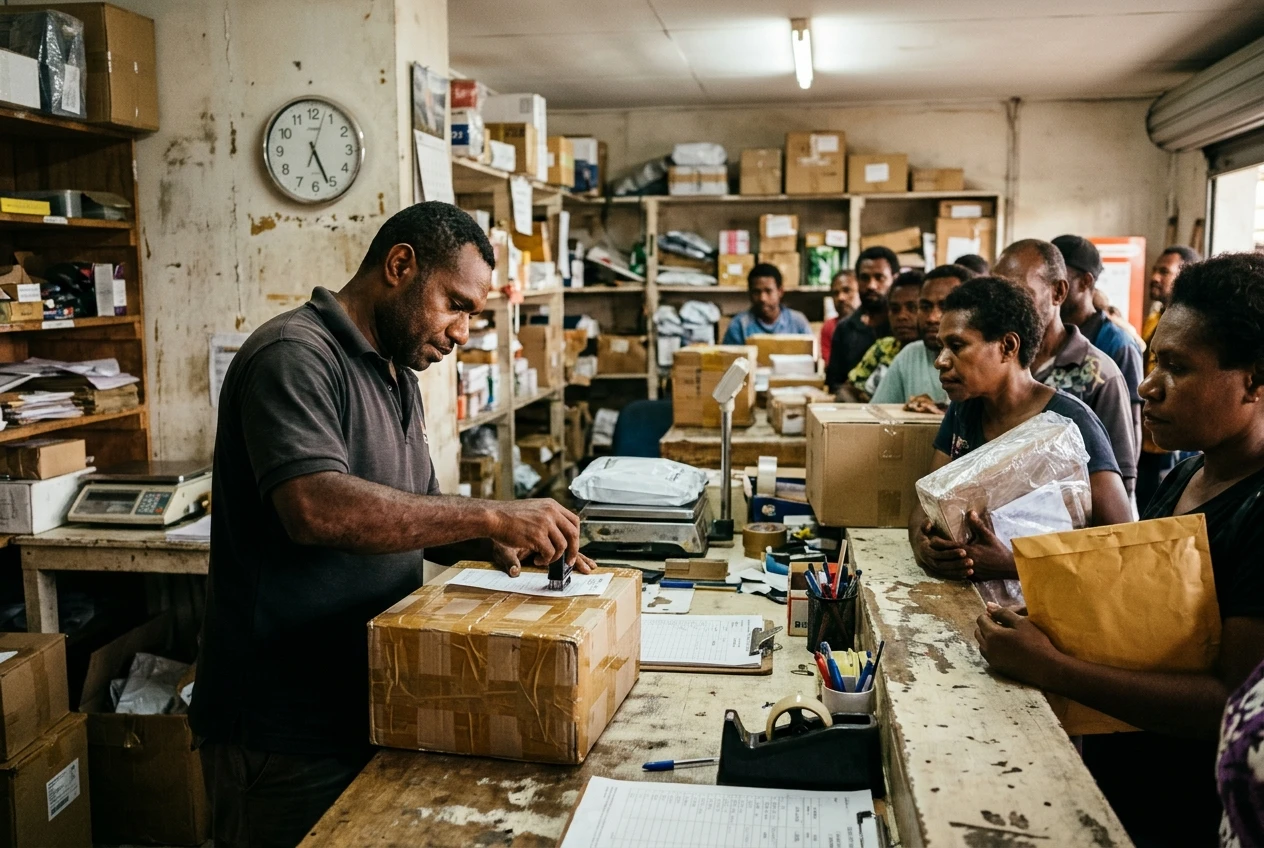
Tracking. Ask exactly what tracking you will get. It might be a tracking number you can look up online, updates by SMS, or a phone call to a depot. Each is useful in a different way, and some services give no tracking at all. Do not assume a feature exists because it is common elsewhere. Ask the provider to show you how tracking works for the service you are buying.
Pickup or drop-off. Collection from your door saves time and travel, and may cost more. Dropping the parcel at a depot or branch can be cheaper, but you must reach it before the cut-off. For delivery, find out whether the courier brings the parcel to the recipient’s door or the recipient must collect it. For many addresses, especially in settlements and areas with unnamed streets, clear directions and a working phone number for the recipient are what make delivery happen.
Proof of delivery. For anything valuable or time-sensitive, ask what proof you will receive: a signature, a name, a photo, a timestamp. This matters most if a customer says a parcel never arrived. Without proof of delivery, you have little to show either way.
Add one more check: how the provider talks about delays. A courier that tells you plainly which conditions can slow a parcel is easier to rely on than one that promises a speed with no conditions.
Matching the courier to your parcel
The parcel itself changes which provider fits.
Documents. Letters, contracts, certificates and application forms are light but often urgent, and sometimes irreplaceable. Choose a service with tracking and proof of delivery, and ask whether original documents need special handling. If a government office or school requires the original paper, a lost parcel costs far more than the postage.
Small business orders. Sellers who ship several parcels a week need consistency more than the lowest price on a single item. Ask about regular pickups, any arrangement for repeat customers, and how the courier handles failed delivery attempts. Tell your customers the delivery window the courier actually gave you, not a hopeful one. A seller who promises two days and delivers in four loses the customer, however good the product is.
Fragile items. Glassware, electronics and ceramics need strong packaging whatever the courier. Ask what the provider says about compensation for damage, and whether insurance is available and what it covers. Read the conditions before you pay. Photograph the packed item and the sealed box before handover, so you have a record if something arrives broken.

Bulky or heavy freight. Furniture, building materials, appliances and large cartons often fall outside a standard parcel service. Check the size and weight limits, and ask whether the provider handles freight at all or refers you to another service. Ask who is responsible for loading and unloading at each end, because that is often where bulky items are delayed.
Sending beyond the capital
Sending a parcel to a province changes the whole calculation. The first question is whether the courier delivers to the town or only to a depot. Many parcels end at a collection point, and the recipient has to travel to pick them up. Ask for the name of the collection point and its opening hours, and pass both to the recipient.
Remote areas add more layers. Some communities can only be reached by air or boat, and flights and sailings can be cancelled or delayed by weather and by operational reasons. Time estimates for these routes are best treated as ranges. If your parcel is urgent, ask the courier what their usual and their longest delivery times have been for that destination.

If you are not sure where a destination sits, the provinces map sorted by region helps you identify the province and the nearest main town. Many remote deliveries are completed through a main centre, and the last stage may involve a local transport arrangement.
Alternative delivery methods are worth asking about when a courier does not serve a location. People often send items with a trusted person travelling to the destination. This can work well, but it carries risk, because the item has no tracking and no proof of delivery. Use it only for things you can afford to lose, and agree handover details with both people in advance.
For any remote destination, give the courier a phone number that the recipient answers, a clear description of where to find them, and a second contact who can receive the parcel if the first person is away.
If your parcel is late
A delay is easier to resolve if you act on it early and keep good records.
Have this ready before you contact anyone:
- The tracking number or receipt number
- The date and time you handed the parcel over, and the branch or rider who took it
- The sender and recipient names, addresses and phone numbers
- A description of the contents and their value
- Photos of the packaging and the receipt
Then work through these questions in order.
- Check the tracking, if the service has it, and note the last recorded location and time.
- Contact the provider through its official phone number, email or branch, quoting the tracking or receipt number. Write down the name of the person you spoke to, the date, and what they said.
- Ask for a specific next action and a date by which you will hear back, not only a general assurance that the parcel is “on the way”.
- If the parcel is international, ask whether it is being held at customs and what documents or payments are needed. Delays at this stage are common and are often resolved by supplying missing paperwork.
- If there is still no answer, follow the provider’s complaint procedure and keep a copy of everything you send.
Check how long the provider’s conditions say you have to lodge a claim for a lost or damaged parcel. Some conditions set a short window, and missing it can end your claim. Check the contact details on the provider’s own official website, and avoid numbers supplied by strangers in comment sections or messages.
Before you pay: a checklist for verifying service and costs
Use these questions every time, because providers update their services and prices. Put them to the provider directly, and save the answers in writing, such as in a message or on a receipt.
- Is this the right organisation? Confirm you are dealing with PNG Post itself, an actual courier company, or an official agent, and not the Post-Courier newspaper or an unofficial account using a similar name.
- Which service, exactly? Get the name of the service and the route it covers.
- What is the delivery time for my route, and what could change it? Ask about weather, flight schedules and customs.
- What is the cut-off time for this service?
- What will it cost in total? Ask about fees for pickup, remote-area delivery, insurance, packaging and customs, as well as the base price.
- What tracking do I get, and how do I use it?
- What proof of delivery will I receive?
- What happens if the parcel is late, lost or damaged? Ask for the written conditions and any compensation limits.
- How do I pay, and what receipt do I get? Keep the receipt until the parcel is delivered and confirmed.
- Can I see this on the provider’s own current information? If the answer exists only in a social media comment, treat it as unconfirmed.
If a provider cannot or will not answer these clearly, that tells you something about how they would handle a problem later.
The best courier for you is the one whose answers match your route, your parcel and your deadline. Compare two or three providers on the same checklist, and the choice is usually clear.
Used a courier in Port Moresby that was fast or that let you down? Tell us through the Contact page so we can keep this comparison accurate and useful for other readers.
