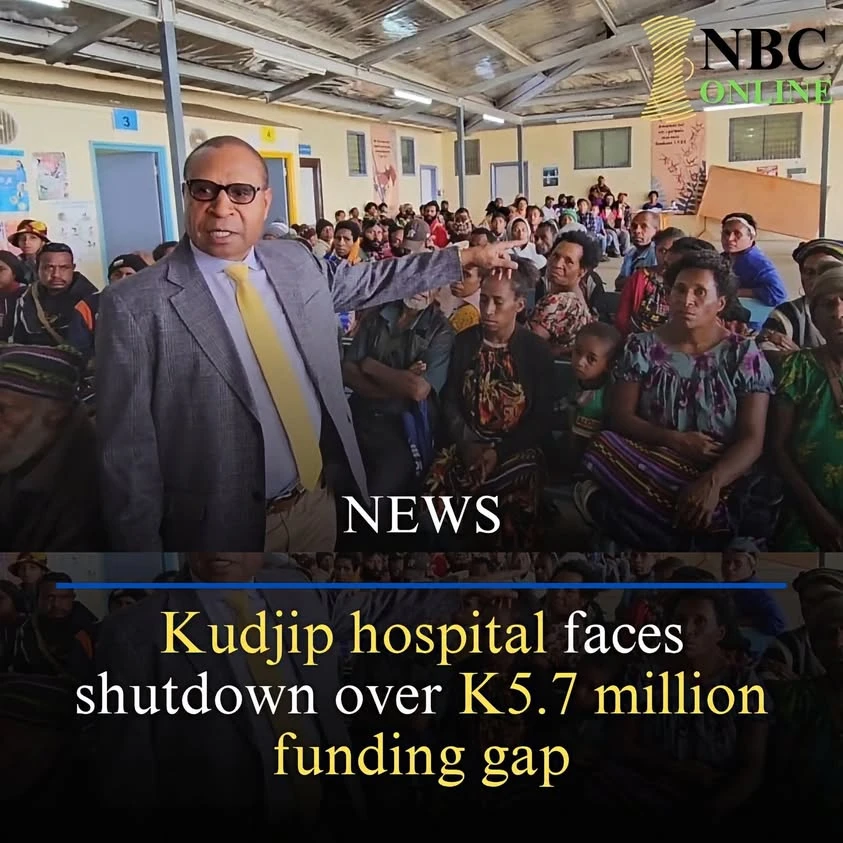
Thousands of patients across Jiwaka and the wider Highlands could lose access to essential healthcare because of the Kudjip hospital funding crisis. Nazarene General Hospital at Kudjip, the province’s main referral facility, has used up its financial reserves, and management says its continued operation is under threat.
A short-term relief package has postponed a planned partial shutdown, but management says the danger of closure remains. This article sets out what is known, what the figures show, and why the outcome matters well beyond one hospital.
Partial shutdown postponed after K2 million in relief
In late October 2026, Nazarene Health Ministries (NHM), which runs the hospital, announced that a partial shutdown planned for Monday, 2 November had been postponed. The postponement was made possible by a combined K2 million relief package: K1.5 million from Christian Health Services (CHS) and K500,000 from the Jiwaka Provincial Health Authority (JPHA).
NHM chief executive officer Paulias Korni and JPHA Board chairman Paulus Ain announced it at a joint press conference, as reported by The National on 26 October 2026.
Korni welcomed the support but said it does not solve the underlying problem. According to the hospital, its financial reserves are fully exhausted. Without further funding, a total and indefinite shutdown is still possible.
The numbers behind the Kudjip hospital funding crisis
These are the key figures released by hospital management:
Item Amount / detail Budgeted operational funding awaited from Government K12.8 million Emergency funding formally requested from Treasury K5.7 million Relief received (CHS + JPHA) K2 million Current staffing level (2026) About 300 Outpatients seen daily Almost 300 Period the K5.7 million would cover Into the first quarter of 2027
Korni explained that the K12.8 million budget request reflects the hospital’s approved organisational structure and current staffing. It does not include the base salaries of staff already paid through the Government’s Alesco payroll system. It covers what management calls “offline” costs, which the hospital has been absorbing at a loss:
- Core hospital operations
- Medical supplies that are currently unfunded
- Personnel costs that sit outside the Alesco payroll
The K5.7 million emergency request is meant to keep cash flowing for staff entitlements, utilities and life-saving supplies while longer-term budget arrangements are settled. Korni acknowledged that this amount does not cover the hospital’s full need. He said the appeal was made with awareness of the fiscal pressure on health facilities across the country.
Which services are at risk?
If the K2 million runs out before further funds arrive, hospital management says closure is likely. That would directly affect:
- The Outpatient Department (OPD), which sees close to 300 patients each day
- Accident and Emergency (A&E)
- Labour and delivery
These services matter most to mothers in labour, accident victims on the Highlands Highway, and families bringing in sick children. If Kudjip stopped providing them, patients would have to travel to other hospitals, such as those in Mount Hagen or Kundiawa. That means more travel time and more cost, for families who often can least afford either.
Why Kudjip matters to the Highlands
Nazarene General Hospital, formerly Kudjip Nazarene Hospital, has been operated by the Church of the Nazarene since 1967. It is a 134-bed facility providing medical, surgical, obstetric, paediatric, emergency and trauma care.
In April 2017, a memorandum of agreement between the National Department of Health, the Jiwaka Provincial Government and the hospital designated it as Jiwaka’s provincial hospital. Jiwaka had been without a provincial hospital since becoming a province, and Kudjip filled that role while remaining a church-run institution.
Church sources describe the hospital as the primary healthcare facility for roughly 400,000 people in Jiwaka. It also receives patients from Western Highlands, Simbu, Eastern Highlands and Enga. Because of that reach, a funding problem at Kudjip quickly becomes a regional health concern.
Development partners have also invested in the hospital. The Australian High Commission reports that the PNG-Australia Partnership’s Incentive Fund has provided three grants to the hospital since 2006, totalling almost K23 million, for facility expansion and upgrades.
A funding problem that keeps returning
Kudjip has warned of closure before. Public reporting shows repeated funding crises:
- 2016: After budget cuts to church health services, hospital administrators warned of possible closure.
- 2019: The hospital reduced services and turned away new outpatients after going roughly a year without Government funding. Reporting at the time pointed to confusion between the provincial health authority, Treasury and the hospital over how its budget as an interim provincial hospital should be submitted.
- 2021: NHM scaled down inpatient services and set a closure timeline before Government funding was restored in September.
- November 2025: Services were scaled back for nearly three weeks until the National Government released K7 million in relief funding. Hospital management said at the time that it needed about K20 million a year to operate and had requested K31 million in the 2026 budget.
The repetition points to a structural issue: how a church-run hospital performing a provincial public hospital role is funded through the national budget.
What the Government has said
In April 2026, Health Minister Elias Kapavore said Kudjip had been certified as compliant under the National Health Services Standards and would be upgraded to Level 5 provincial hospital status. He said the hospital would be considered for a separate budget vote in the 2027 National Budget and that its health workforce could be placed on the Alesco payroll.
If carried through, that plan would address the long-term problem. The immediate question is how the hospital gets through the months before 2027 funding actually arrives.
To prevent further delays, Korni and Ain have called on Treasury to itemise the NHM budget under a specific budget line (item 116). Ain said he would follow up with the Department of Health and Treasury, noting that the submission was already lodged last year. NHM has also appealed directly to the Prime Minister to direct Treasury to warrant and release the K5.7 million emergency funding.
What Kudjip shows about health funding in PNG
Churches deliver a large share of health services in Papua New Guinea, especially in rural and remote areas. When their funding arrives late or falls short, ordinary people feel the effect before budget officers do. The cost of keeping public facilities running is also a wider question, which we look at in who looks after PNG’s new roads, bridges and clinics after the ribbon is cut.
The Kudjip situation raises practical governance questions that apply nationwide:
- Clarity of funding channels. When a church facility takes on a public hospital role, the budget pathway needs to be explicit and itemised so funds are not delayed by administrative uncertainty.
- Timeliness of warrants. A budget allocation only helps patients once Treasury warrants and releases it. Delays force hospitals to run down reserves or cut services.
- Full-cost budgeting. Kudjip’s figures show that “offline” costs such as supplies, utilities and non-payroll staff can be substantial. A budget that covers salaries alone leaves a deficit that the hospital has to carry.
- Stable planning. Relief payments every few months keep the doors open, but they make it hard for hospitals to plan staffing, procurement and maintenance.
What happens next
For now, Kudjip remains open because of the K2 million relief package. Its position in the coming weeks depends largely on whether the K5.7 million emergency request is approved and released, and whether the budgeted K12.8 million is paid.
Over the longer term, the promised separate budget vote in 2027 could give the hospital a predictable funding base. Until then, patients across Jiwaka and the Highlands are waiting on those decisions. Papuaniugini.org will continue to follow this story and update readers as new information becomes available.
Frequently asked questions
Is Kudjip hospital closed? No. As of the end of October 2026, a K2 million relief package has postponed a partial shutdown that had been planned for 2 November. Management warns that closure remains possible if further funding is not released.
How much funding does the hospital need? Management says it is awaiting K12.8 million in budgeted operational funding and has requested K5.7 million in emergency funding to operate into the first quarter of 2027.
Which services would be affected by a closure? The outpatient department (close to 300 patients daily), accident and emergency, and labour and delivery.
Who runs the hospital? Nazarene Health Ministries, a ministry of the Church of the Nazarene, operating under an agreement with the national and Jiwaka provincial governments as the province’s provincial hospital.
Sources: The National (26 October 2026; 22 April 2026; 24 and 28 November 2025), NBC News PNG (28 November 2025), Australian High Commission PNG, Asia-Pacific Church of the Nazarene, Samaritan’s Purse, EMTV.