

Papua New Guinea’s resource wealth has produced some of the fastest growth in the Pacific, yet daily life for most people has changed far less than the headline figures suggest. The World Bank’s Papua New Guinea Economic Update (June 2026) reports that the economy grew by 5.6 per cent in 2025, one of the strongest results in the region.
The same report finds that formal employment per person has declined. Most new workers are entering subsistence farming and low-productivity informal work instead of secure jobs.
PNG’s gold, copper, oil and gas bring in large export earnings, but those earnings have not produced broad, lasting development. This article sets out the evidence, the constraints and the practical priorities that development partners and economists keep returning to.
The Numbers Behind the Resource Economy
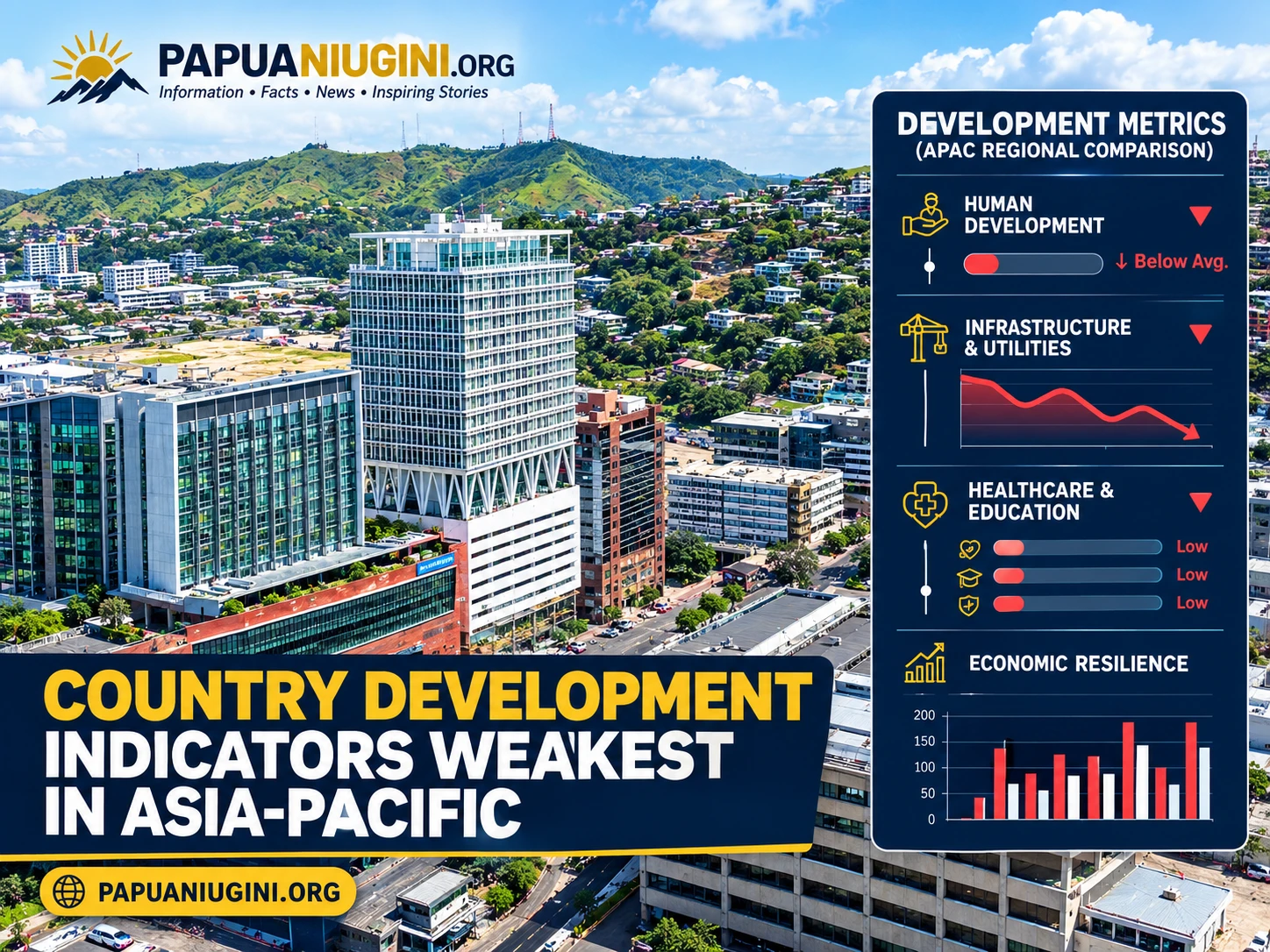
The economy depends heavily on resources, while most people do not work in them.
- Share of GDP: Development Policy Centre analysis published in 2025 estimates that around 27 per cent of GDP comes from the resource sector, which makes PNG one of the most resource-intensive economies in the world.
- Share of exports: Mining and petroleum make up roughly 80 to 85 per cent of export value, according to civil society analysis by ACT NOW! PNG.
- Livelihoods: The World Bank notes that agriculture supports the livelihoods of more than 85 per cent of the population.
Most export earnings come from mines and gas fields, and most people earn a living from the land.
The 2026 Budget and Papua LNG
Treasurer Ian Ling-Stuckey delivered the 2026 National Budget in November 2025. It includes:
- Record expenditure of K30.91 billion, 9 per cent more than in 2025
- Projected real GDP growth of 4.0 per cent, with inflation forecast at 4.2 per cent
- A deficit expected to fall to 1.1 per cent of GDP, down from 8.9 per cent in 2020, with a surplus targeted for 2027
- Debt-to-GDP falling from 48.4 per cent in 2025 to 45.5 per cent in 2026
The Government projects the economy reaching around K145 billion in 2026 and K200 billion by 2030 as new resource projects start production.
Much of that growth depends on Papua LNG in Gulf Province. In September 2026, TotalEnergies announced that ExxonMobil would take over as operator, with capital expenditure revised to around US$14 billion and planned output of 5.6 million tonnes of LNG a year. Partner Santos said in August 2026 that a final investment decision was targeted for the fourth quarter of 2026. That decision has already been delayed three times, in 2020, 2024 and 2025.
If the project goes ahead, it will add significantly to national output. Whether it improves life for ordinary people depends on how its revenue is managed.
Growth Without Transformation: What the Evidence Shows
An Enclave Sector
Researchers have long described PNG’s resource sector as an enclave: capital-intensive, largely foreign-owned, employing few nationals and buying little from the rest of the economy. Earlier research in the Pacific Economic Bulletin found that it employs a small fraction of the workforce and very few of the poor. For a wider look at the mines themselves, see how mining shapes PNG: the mines, the money and the rules.
Because few people work in the sector, its main link to ordinary citizens is government revenue, and that link has been weak. Lowy Institute analysis found that by 2020 the resource sector made up just under a quarter of GDP but contributed only about one per cent of GDP to government revenue. The same analysis concluded that the average Papua New Guinean was worse off in 2020 than in 2013.
Human Development Indicators
- PNG ranks 154th out of 193 countries on the UN Human Development Index (UNDP).
- Only around 20 per cent of the population has reliable electricity, according to UNDP. World Bank data puts national access at about 20.5 per cent in 2023.
- Recent ADB analysis notes that a large share of the population is multidimensionally poor and highly vulnerable to economic shocks.
For families in rural villages and remote outstations, the resource boom has often brought little change in access to roads, power, clean water, health care or schools.
Four Constraints Holding PNG Back
Development partners, business surveys and the Government’s own budget priorities point to four connected constraints.
1. Governance Weaknesses
Resource revenue becomes services only when institutions collect it fairly, budget openly and deliver funds where they are needed. The World Bank’s Country Partnership Framework for PNG (FY2026 to FY2031), approved in February 2026 with an estimated US$1.2 billion financing envelope, lists economic governance and resource revenue management among its core priorities.
The Government has acknowledged the delivery problem. Ahead of the 2026 Budget, the Prime Minister said the focus was on making sure Treasury and Finance releases reach communities. PwC PNG described the Budget’s projected 15.3 per cent revenue growth as a bold assumption in a period of global uncertainty.
2. Law and Order
Business has raised law and order as a concern for more than two decades.
- A World Bank survey of 135 businesses found that 81 per cent said law and order affected their investment or expansion decisions. More than two-thirds employed private security, about four times the regional average, and nearly a third spent 10 per cent or more of operating costs on it.
- The annual PNG 100 CEO Survey has listed security and law and order among the top five business constraints every year since 2014.
The 2026 Budget raised law, justice and national security spending by 9.6 per cent, to around K2.5 billion. The World Bank’s research cautions that heavy reliance on private security can shift responsibility away from the police, and it recommends a coordinated approach to the underlying causes of violence.
3. Infrastructure Deficits
PNG’s rugged terrain makes roads, power lines and ports expensive to build. With roughly four in five people lacking reliable electricity, and many communities without year-round road access, farmers struggle to get produce to market and small businesses struggle to grow.
The 2026 Budget set the capital budget at K10.866 billion, including K7.697 billion for roads and development projects under the PNG Connect program. The test is whether these projects are finished, maintained and extended to rural districts as well as towns.
4. Low Investment in Human Development
PNG has a young and growing population, but young people can only take up productive work if they have the health, education and skills for it. The World Bank’s 2026 framework puts building skills and human capital first among its priorities. PwC’s commentary notes that 2026 spending growth focuses on security, education, health and agriculture. Sustained, well-targeted spending in these areas will decide whether new jobs go to Papua New Guineans.
Why Private Investment Outside Resources Remains Thin
These four constraints raise the cost and risk of doing business outside mining and petroleum. Two further pressures add to them:
- Limited access to credit: ADB analysis puts private sector credit at around 16.5 per cent of GDP, which is low by regional standards.
- Foreign exchange shortages: Business Advantage PNG reports that forex shortages have been the single biggest impediment to business in PNG for more than a decade.
As a result, resource exports can lift GDP while the farms, small enterprises, tourism operators and manufacturers that employ most people find it hard to expand. The World Bank’s 2026 Update names three pillars to address this: strengthening economic foundations, improving the business-enabling environment and mobilising private capital.
Rising costs also reach households. Readers planning their own spending can look at these budgeting tips and tools.
What Is Going Right
PNG’s economic story includes real progress:
- Fiscal repair: The deficit has fallen from 8.9 per cent of GDP in 2020 to a projected 1.1 per cent in 2026.
- Non-resource growth: The Government reports six consecutive years of non-resource growth above 4 per cent, the longest such run in PNG’s history.
- Falling debt ratio: Debt-to-GDP is projected to keep falling.
- New partnerships: The World Bank’s US$1.2 billion framework is built around jobs, services and diversification, including agriculture.
Growth exists. What remains is getting it to people as jobs, services and opportunity.
What Will It Take?
The World Bank, ADB, independent economists and business surveys point to six priorities:
- Manage resource revenue transparently. Papua LNG and later projects should deliver a fair share to the State, landowners and provinces, and the public should be able to see where the money goes.
- Invest in agriculture. With more than 85 per cent of people relying on it, better roads, extension services, market access and processing can raise incomes where most people live.
- Build and maintain rural infrastructure. Roads, power and telecommunications that reach provinces and outstations make farming, small business and services viable.
- Strengthen security through institutions. Fund police, courts and community justice, and address the causes of violence instead of relying on private guards.
- Prioritise health, education and skills. A healthy, skilled workforce can fill the jobs that new investment creates.
- Improve the business environment. Resolving foreign exchange shortages, widening access to credit and simplifying regulation can help local firms grow.
None of these is new and none is quick, but the evidence points the same way: the countries that benefit from resource wealth are the ones with working institutions, infrastructure and educated people.
Conclusion
PNG enters its next 50 years with economic momentum, a stronger fiscal position and major resource projects ahead. The gap between growth on paper and progress in people’s lives is still wide. Whether the next resource boom changes that depends on decisions about revenue, roads, schools and security, made in Waigani, in the provinces and in communities across the country.
What do you think it will take to turn PNG’s resource wealth into lasting national progress? Share your thoughts in the comments below.
Sources
- World Bank: Papua New Guinea Economic Update, June 2026
- World Bank: Country Partnership Framework FY2026 to FY2031
- World Bank: PNG Economic Update, June 2025 (agriculture focus)
- NBC News: PNG announces record K30.9 billion budget for 2026
- PNG Government: Marape-Rosso Government releases K30.9 billion 2026 Budget
- Office of the Prime Minister: PM welcomes 2026 Budget
- Business Advantage PNG: 2026 National Budget: what’s in it for business?
- PwC PNG: 2026 Budget commentary
- Development Policy Centre: How resource-rich is Papua New Guinea really?
- Lowy Institute: Papua New Guinea: lessons of the last decade in four charts
- UNDP Papua New Guinea: PNG in numbers
- ADB: Country Partnership Strategy PNG 2026 to 2030, growth and poverty annex
- Development Policy Centre: Two-thirds of PNG businesses employ security guards: World Bank
- Business Advantage PNG: PNG 100 CEO Survey
- World Oil: ExxonMobil to take operatorship of Papua LNG
- Intellinews: Papua LNG on track for FID by end of year
- ACT NOW! PNG: From Extraction to Inclusion: FAQ