Do you know the history of Tok Pisin? Papua New Guinea has more than 800 living languages, and linguists count them differently depending on where they draw the line between a language and a dialect. Many of those languages have only a few thousand speakers, and some have fewer. A person from the Sepik, a person from Manus and a person from the Southern Highlands can all be Papua New Guinean without sharing a single mother tongue.
The history of Tok Pisin explains how one language ended up bridging those gaps. It did not start as a national language. It began as a contact language among workers who had been brought together by force and by wage labour, and it grew because people kept finding new things to use it for.
Why a country with hundreds of languages needed a common one
A language only has to be shared when people from different groups need to deal with each other regularly. For most of the history of the New Guinea region, trade networks, marriage ties and shared borders produced a good deal of bilingualism, and some trade languages carried across regions. Few of them reached beyond their own area.
That changed when large numbers of people from many different language groups began living and working together in the same place. Plantation compounds, mission stations, police barracks, hospitals, towns and later schools and workplaces all brought together people with no common language. They needed something quicker to learn than each other’s mother tongues, and Tok Pisin filled that need.
Where Tok Pisin came from: labour trade, plantations and contact languages
Tok Pisin belongs to a family of English-based Pacific pidgins and creoles. Its relatives are Bislama in Vanuatu and Pijin in the Solomon Islands. Linguists trace the family to the 19th century, when English-speaking sailors, traders and whalers used a simplified jargon English in dealings with Pacific Islanders.
The labour trade developed that jargon further. From the later 1800s, workers from Melanesia were recruited, and often coerced, to work on plantations in Queensland, Fiji and Samoa. Workers who came from different islands and spoke different languages communicated with each other and with their employers in a form of pidgin English. Many of them later returned home, and they took this speech with them.
In what became German New Guinea, plantations on the Gazelle Peninsula and along the north coast recruited workers from across the region. The compounds mixed people from dozens of language groups, and the working language was the pidgin that returning labourers and others already knew. This is the language that became Tok Pisin.
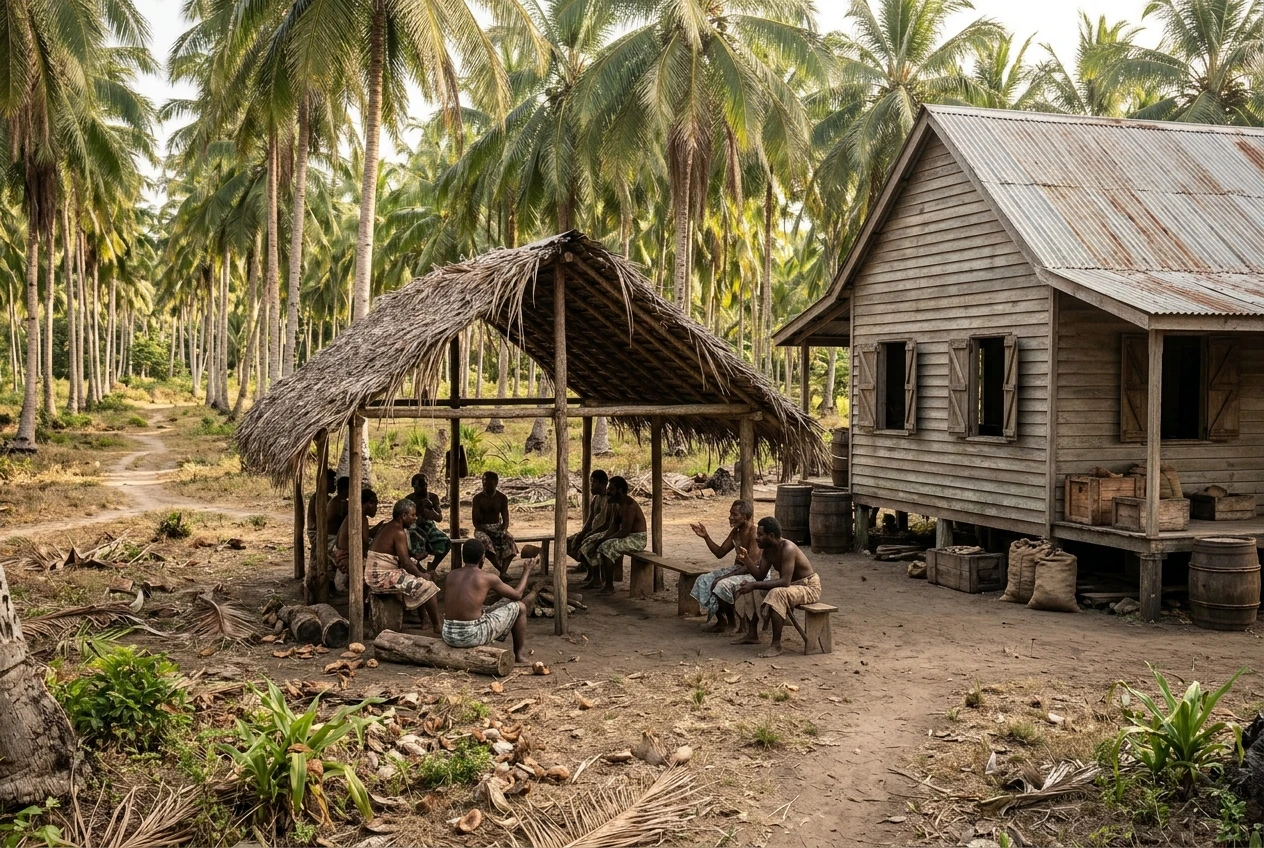
The name itself is plain. Tok comes from English “talk”, and pisin comes from “pidgin”, a word that is usually traced to the English pronunciation of “business”.
Most of the vocabulary comes from English, but not all of it. Some words come from German, such as rausim, “to remove”, from heraus. Others come from Tolai, the language of the Gazelle Peninsula, and from other local languages. The grammar draws on the languages of the speakers who shaped it. A good example is the pair of words for “we”. Yumi means “we, including you, the person I am speaking to”, while mipela means “we, but not you”. English has no such distinction, and many Austronesian and Papuan languages do.
For the national timeline around this period, including the German, British and Australian administrations, see our Papua New Guinea history timeline. This article stays with the language.
From a second language to a first language for many families
A pidgin is, by the usual linguistic definition, nobody’s first language. It is a simplified code used between people who each have another language at home. Tok Pisin passed that stage, and linguists describe the change as pidgin to creole.
The change happens when children begin to acquire the language as their first. In Papua New Guinea this has happened most in towns, where parents from different language groups often use Tok Pisin as the language of the household. Children who grow up hearing it from birth speak it fluently, and in doing so they settle its grammar and expand its vocabulary. Linguistic studies since the 1970s have recorded this process in urban families.
Some of that grammar is easy to see. Mi kaikai pinis means “I have eaten”, where pinis marks a completed action. Baidu mi go means “I will go”, where bai marks the future. Em i stap can mean “he is there” or “she is staying”. These markers do work that a bare pidgin would leave to context.
Estimates of how many people speak Tok Pisin vary by source and by year, depending on whether the count includes people who understand it, people who speak it as a second language, and people who speak it as a first. The safest statement is that it is a first language for a minority, a second language for a large majority of the population in many regions, and the language most commonly used between people who do not share a mother tongue. If you quote a number, name its source and its year.
How Tok Pisin spread through church, the Wantok newspaper, radio and politics
A contact language does not reach a whole country by plantation work alone. Four institutions carried Tok Pisin much further.
Church. Missions used a range of local languages and lingua francas, and Tok Pisin became one of the most useful for congregations drawn from many language groups. The Tok Pisin New Testament, Nupela Testamen, was published in 1969, and the complete Bible, Baibel, followed in 1989. Preaching, hymns and Bible reading in Tok Pisin gave the language a written, formal register, and gave many people their first experience of reading it.
The Wantok newspaper. Wantok Niuspepa is a weekly newspaper published in Tok Pisin, begun around 1970 with church backing. Its name comes from wantok, literally “one talk”, meaning a person who speaks your language and, by extension, a relative or someone with whom you share obligations. A newspaper written in Tok Pisin showed that the language could carry news, opinion and explanation, and it helped standardise spelling.
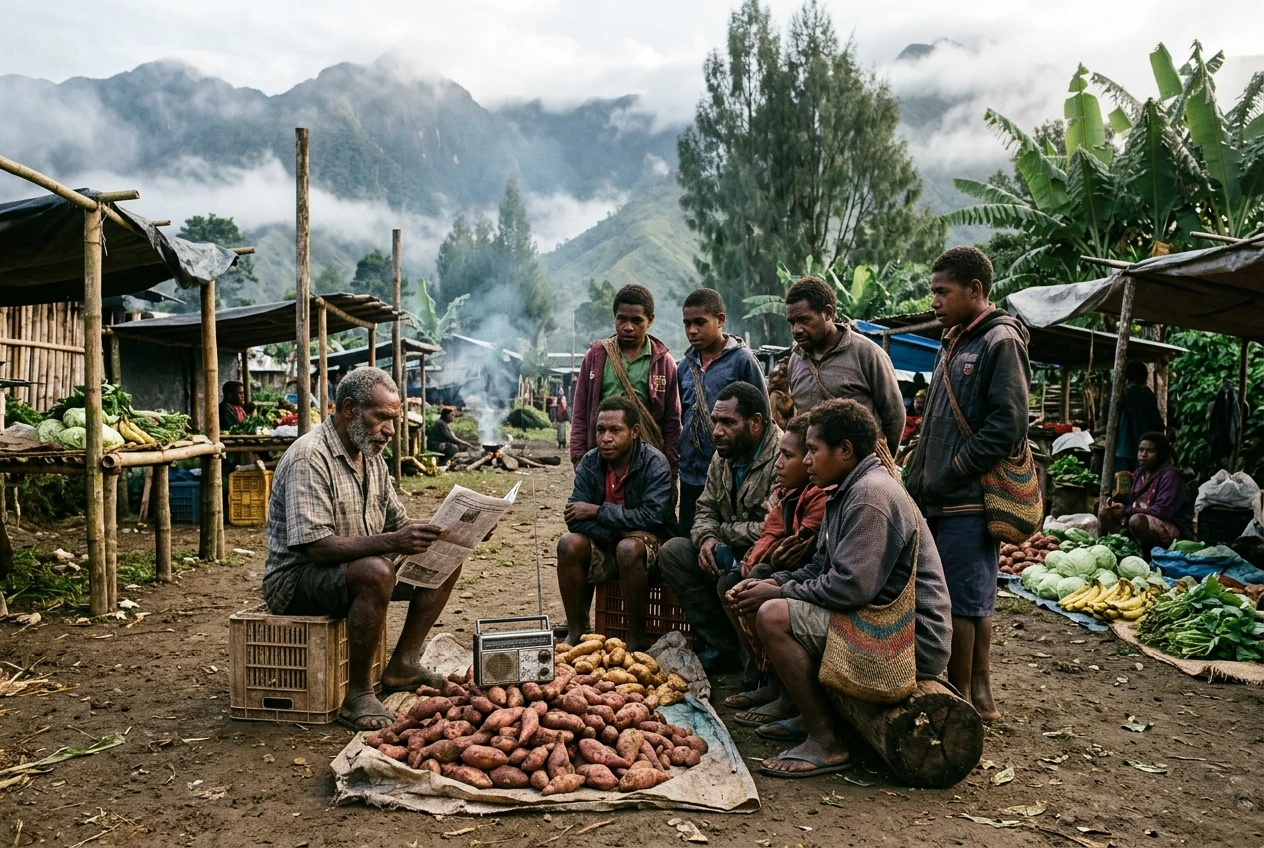
Radio. Radio reached people who could not read and lived far from towns. The National Broadcasting Corporation broadcasts in Tok Pisin along with English and Hiri Motu, and provincial stations add local languages. For many listeners, radio is where Tok Pisin carries national news and public information.
Politics. Candidates who campaign across language boundaries need a language that large audiences understand. Tok Pisin is used heavily in campaigns, public meetings and, in practice, in parliamentary debate, and Tok Pisin phrases such as tok save, meaning a public notice or announcement, are part of everyday public life.
Tok Pisin, English and Hiri Motu: what the official language position actually says
The question “What are PNG’s official languages?” gets different answers from different sources. The most common one is that Tok Pisin, English and Hiri Motu are the three official languages, with PNG Sign Language added as a fourth in 2015. You will find that statement on many reference websites.
The picture in law and practice is more layered, and sources do not always agree on how the status was created. English is the language of most legislation, formal education and government paperwork. Tok Pisin and Hiri Motu are recognised for use in public life, including in Parliament. The Constitution’s national goals and directive principles also give weight to local languages and cultural heritage.
For the exact legal wording, go to the text of the Constitution and the Parliament’s Standing Orders rather than a summary. If you are writing a school assignment or a research paper, cite the document itself, not a website that repeats the common version.
Hiri Motu has a history of its own. It grew from the Motu trading language used on the hiri trading voyages along the Papuan coast, was simplified into the form once called Police Motu, and spread through the police force and administration in Papua. It is spoken by far fewer people than Tok Pisin today, mostly along the Papuan coast and in parts of the Southern region.
Is Tok Pisin uniting Papua New Guineans, or competing with village languages?
Both things are true in different places, and the evidence points to a more mixed picture than either side of the argument admits.
For most speakers, Tok Pisin is added to a village language, not swapped for it. A person might speak a tok ples (a local language) at home, Tok Pisin in the market and at church, and English at work or school. In rural areas, Tok Pisin is often shaped by the speaker’s village language in pronunciation and word choice. Linguists sometimes call this rural Tok Pisin, to distinguish it from the urban variety, which uses more English-derived vocabulary.
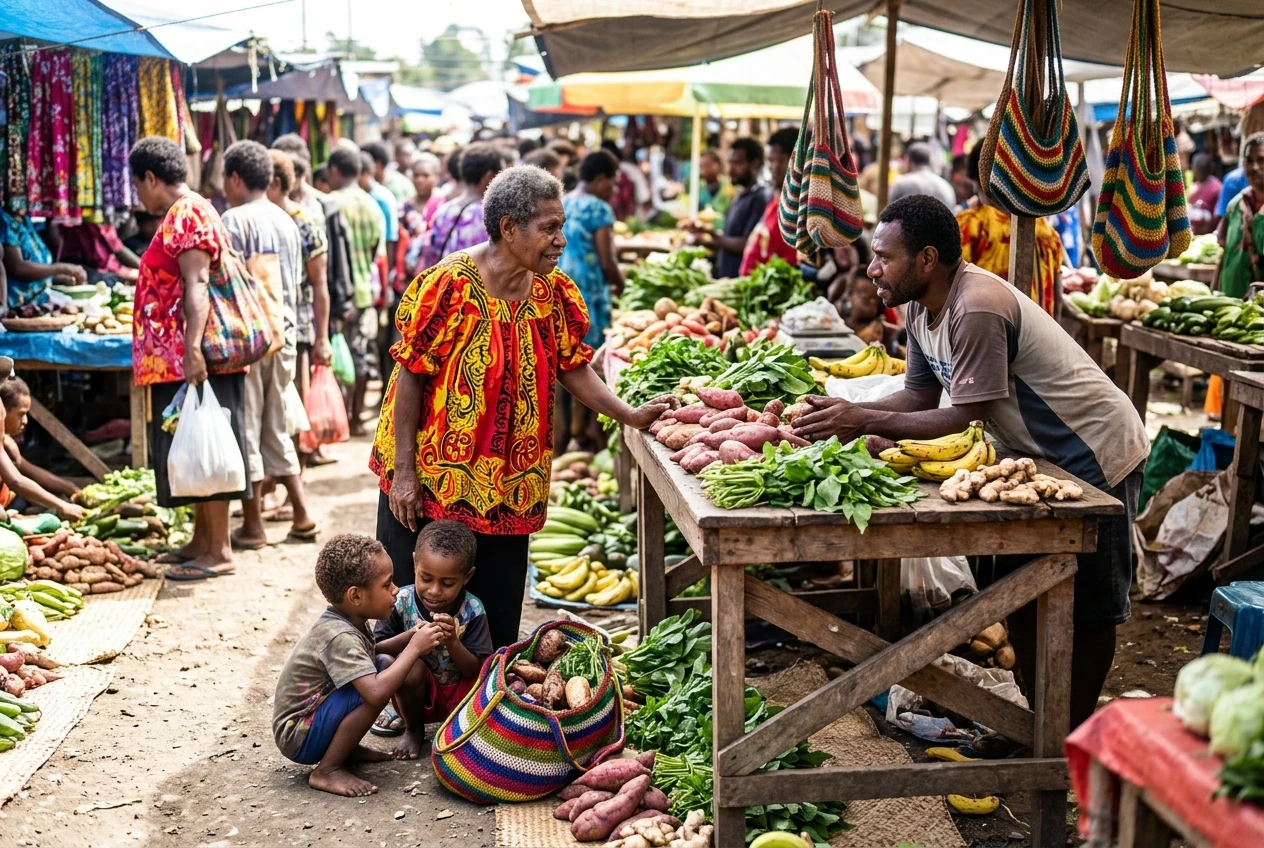
The risk comes in towns and in mixed-language families. When parents from different language groups speak Tok Pisin at home and the children never learn either parent’s mother tongue, the village languages stop being passed on within that family. If this happens in enough families over enough generations, small languages can disappear. Linguists who study endangered languages in Papua New Guinea have raised this concern.
The language also carries a cost for those who cannot use it well. Tok Pisin works well for everyday matters, but some people find it harder for technical, legal and scientific subjects, where English has a larger vocabulary. That gap is shrinking as Tok Pisin borrows and coins new words, which is how languages normally grow.
The honest summary is that Tok Pisin unites people across language lines at the national level, and in some families it competes with the mother tongues at home. Whether it does one or the other depends on whether the village language is still spoken in the household.
Tok Pisin today: school policy, social media, and keeping it strong overseas
Schools. School language policy in Papua New Guinea has changed more than once. The reform that began in the 1990s introduced elementary classes taught in the child’s community language in the early years, with English introduced gradually. Later policy changes have put more emphasis on English. If you are a teacher or student researching this, check the current Department of Education policy, because older articles and summaries may describe a position that has since changed.
Social media. Tok Pisin is widely written on Facebook and in messaging. That matters for the language because people now read and write it in everyday settings, where for a long time most written material was religious or in newspapers. Spelling is less settled in casual posts than in published texts, which is normal for any language in informal writing.
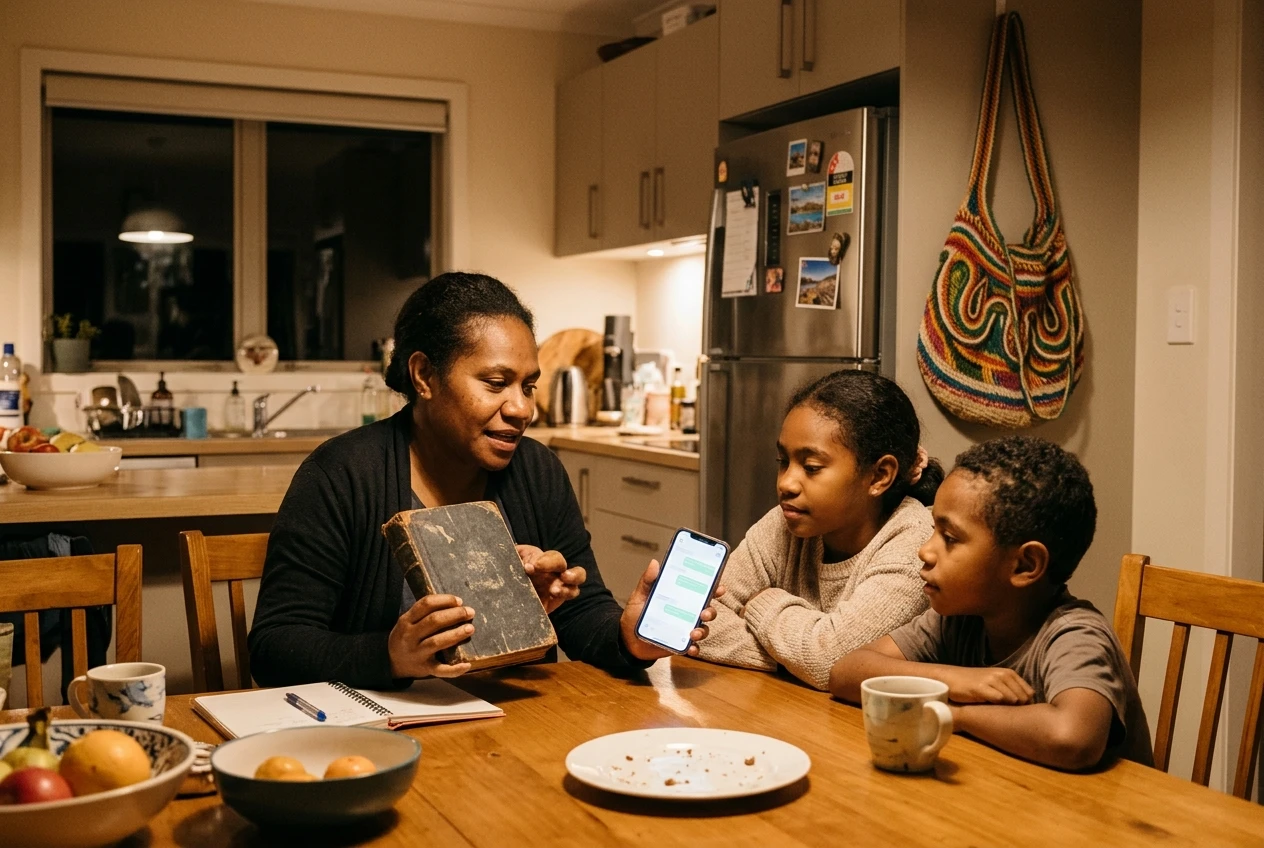
Overseas. For Papua New Guineans living outside the country, the most reliable way to keep a language alive is to use it at home with children, since a language survives where it is spoken in daily life. Reading and listening also help, whether that is a Tok Pisin Bible, a Wantok edition or radio broadcasts. Anything people read and say in Tok Pisin tells their children that it is a language for real conversations, not only for greetings.
For readers. If you want to see how far Tok Pisin reaches into everyday life, notice how often a single word does the work of a sentence. Wantok names a relationship, tok save names a public duty to inform, and maski means “never mind, forget it”. For more country facts to place the language in context, see 50 Interesting Facts About Papua New Guinea.
Tell us how Tok Pisin is spoken in your province or community, and send us a favourite expression with its English meaning. We may feature reader contributions in a future PAPUANIUGINI.ORG article on everyday PNG language.