If a company puts exploration camps on your clan’s graun (land), who is entitled to what? The answer is in the Mining Act 1992, in the agreements signed around it, and in how groups of landowners are identified. Landowner benefits in PNG mining depend heavily on paperwork: who is named, what is written, and what is actually paid.

This guide explains how compensation, royalties and benefits are set, how agreements are negotiated, and where disputes tend to begin. It is general information, not legal advice. Laws are amended and every project has its own agreements, so the sections below flag what to check with the Mineral Resources Authority (MRA) and a lawyer.
Why landowners and the state deal with each other differently over minerals
In most of Papua New Guinea, land is held under custom by clans and other groups, not by individuals with titles. Minerals are treated differently. Under the Mining Act 1992, minerals in the ground belong to the State, whoever owns the land above them.
This is why the relationship is different from, say, a company buying a block in town. Landowners do not own the gold or copper, so they negotiate over access to their land, damage to it, and a share of what the project earns. The State has its own interests: taxes, royalties, and a role in approving projects.
Many landowners have long argued that this arrangement leaves them with the disruption and too small a share of the returns. Others point out that a State-owned resource is meant to benefit people across the country, not only those living at one mine site. Both views are part of the debate, and any agreement is shaped by it.
For the national picture, our article on PNG resource wealth and growth without transformation looks at what mining has meant for the economy as a whole. This article stays with the landowner group and the documents it signs.
Compensation, royalties and benefits: three things people often confuse
These three words are often used as if they meant the same thing. They are different payments, owed by different parties, for different reasons.
- Compensation is payment for loss or damage caused by the project. Examples include destroyed gardens and trees, houses that have to move, lost access to hunting or fishing areas, and damage to places of cultural importance. The Mining Act sets out the principle, and the details usually appear in a compensation agreement or schedule of rates.
- Royalties are payments based on the value of the minerals produced. The developer pays them to the State under the law. The State then shares them with the provincial government and landowners according to the rules or agreements that apply to that project. Landowners therefore do not normally receive royalties directly from the company.
- Benefits are the wider package: things like equity, community infrastructure, scholarships, training programs, business opportunities and employment commitments. These are mostly set by negotiated agreements, so they differ a great deal from one project to another.
The confusion matters because people often judge a project by one payment. A landowner group may receive generous compensation for gardens and still find that the royalty share is smaller than expected. Or a group may see a new school and assume that compensation has been settled, when it was never discussed. Ask which of the three any given payment or promise falls under.
The current royalty rate and how it is divided should be confirmed with the MRA and the project’s own agreements, because both can change and neither is the same everywhere.
Who counts as a landowner and how groups are identified
Landownership in PNG is held by customary groups, and the rules for who belongs differ across regions. In some areas land passes through the father’s line, in others through the mother’s. Boundaries are often known through shared memory, with stories, landmarks and past agreements between neighbours serving as the record. Our piece on village elders and custom in PNG explains how authority and decision-making work inside these groups.
A mining project needs to know which groups hold rights in the project area, because those groups are the ones who sign agreements and receive payments. This is usually done through landowner identification or social mapping studies, which record clans, sub-clans, genealogies and claimed boundaries.
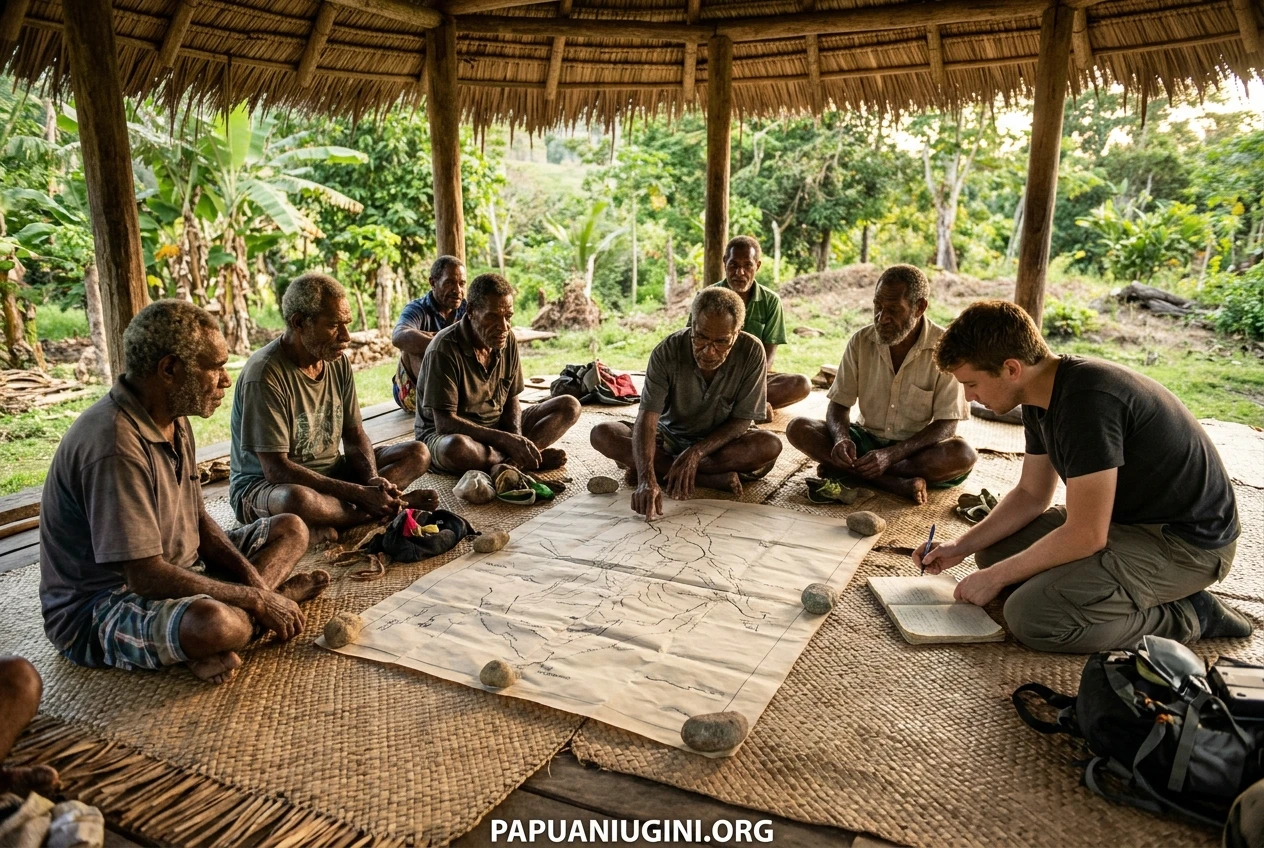
Groups are generally asked to organise in a form the law recognises. A common route is registration as an Incorporated Land Group under the Land Groups Incorporation Act, which gives the group legal standing to sign documents and hold money. Landowner associations and landowner companies are also used, depending on the project. Ask the MRA and a lawyer which structure applies to your project and who the registered representatives are.
Several problems tend to arise at this stage:
- A clan or sub-clan is left off the list, or placed under another group.
- Boundaries are recorded differently by neighbouring groups.
- A small number of leaders sign for a large group that did not agree.
- People who live along rivers or roads affected by the project do not own land at the mine site, and so may not be treated as landowners at all. The experience of villages downstream of Ok Tedi along the Ok Tedi and Fly Rivers is the best-known example of this question.
Identification is more than a formality. It decides who is at the table, and people who are not at the table are rarely in the agreement.
From warden’s hearing to Development Forum: how agreements get negotiated
The sequence below is a general outline. Names, order and requirements differ by licence type and project, and the law may have been amended since this was written, so confirm the steps for your own project with the MRA.
- Exploration. A company applies for an exploration licence. If it is granted, the company can survey, drill and sample, and it should compensate for damage to gardens, trees and other property. This is the first point at which landowners deal with the company directly.
- Studies and consultation. If exploration finds something worth developing, the company carries out feasibility, social and environmental studies. Environmental approvals are handled by the Conservation and Environment Protection Authority under the Environment Act, and the process includes consultation with affected communities.
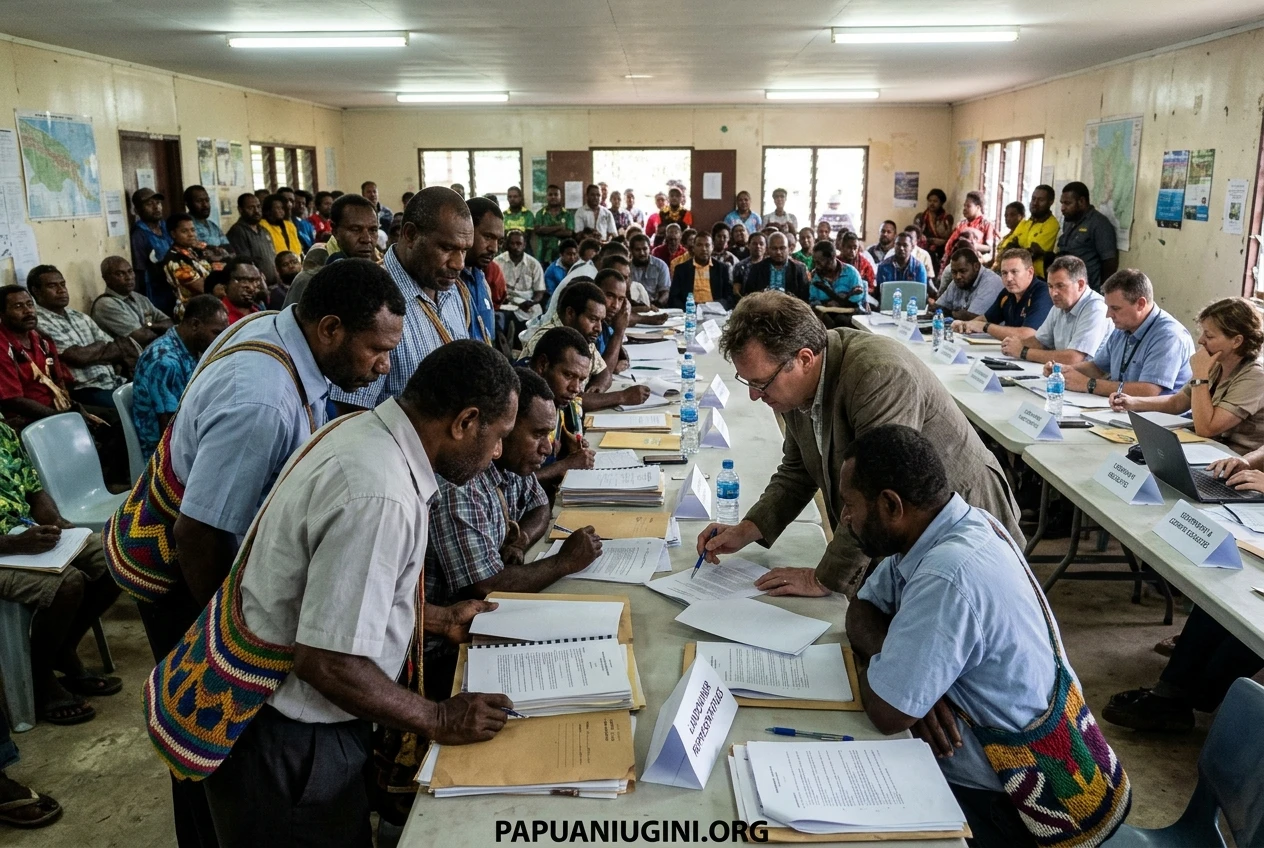
- Warden’s hearing. A mining warden holds a hearing in or near the project area on an application for a lease. The hearing is a legal opportunity for landowners to state who they are, raise objections, and make claims about compensation. What you say there is recorded, so it is worth preparing with advice.
- Development Forum. For larger projects, the government convenes a Development Forum. It brings together the national government, the provincial and local-level governments, landowner representatives and the developer to negotiate the social and economic terms of the project.
- Signed agreements. The forum typically ends with a memorandum of agreement, sometimes along with separate agreements on benefit sharing. A mining development contract between the State and the developer is a separate document, and landowners are not necessarily parties to it.
A Development Forum can be crowded and fast, with many parties, many interests and a limited time. Landowner representatives who arrive without independent legal advice, without a clear mandate from their group, or without having read the documents beforehand are at a disadvantage. This is why preparation matters well before the forum is called.
What a benefit agreement can contain and what to read before signing
Agreements vary, but most contain some or all of the following.
- Compensation rates and when they are paid
- How royalties are shared and who holds the money
- Equity or shareholding arrangements for landowners or their companies
- Commitments on roads, schools, clinics, water and power, with timelines
- Preference for local employment, training and business contracts
- Environmental monitoring, reporting and what happens if damage occurs
- How the agreement is reviewed, changed or ended
- How disputes are resolved
Before anything is signed, read it closely or have it read to you. These points are worth checking.
Who signs and for whom. Check that the people signing hold a real mandate from the whole group, and that every identified group is included. An agreement signed by people who do not speak for the group can be challenged later, and challenges take years.
What is a firm commitment and what is only a wish. Promises made in meetings and speeches are not the same as clauses in the document. If a school, bridge or clinic matters to your community, find it in the text, with a date and a named party responsible for it.
What you are giving up. Some agreements include statements that a group accepts payment as full settlement of certain claims. Understand exactly which claims, for how long, and whether future damage is covered.
Language. If the document is in legal English, ask for an explanation in Tok Pisin or the local language, and have a lawyer explain it as well. Your own lawyer works for you. A lawyer provided by a company works for the company.
Review clauses. Mines can operate for decades, and what is fair at the start may not be fair twenty years later. Check whether payments or terms are reviewed, who triggers a review, and what happens if the parties disagree.
Employment promises. If jobs and training are part of the agreement, read exactly what is promised: preference, quotas, training places or just encouragement. When people start looking for work connected to a project, scams follow. Our guide on how to check a PNG mining recruitment agency is worth reading before anyone hands over documents or money.
Equity deserves a separate question. The State may hold a share in a project, and part of that share can be offered to provincial governments or landowners. If it is part of your agreement, ask how it is held, who manages the money, how landowners receive dividends, and what happens if the project is sold or its ownership changes. Do not rely on a summary: ask to see the document.
Where disputes start and the options when they do
Most disputes start with a small number of recurring problems.
- Identification. A group says it was missed, or that the wrong group was recorded as owner of a particular area.
- Distribution. Money reaches the landowner company or association but not the members, or reaches some clans and not others.
- Leadership. The people who signed the agreement are no longer trusted by the group, or two sets of leaders each claim to represent it.
- Unmet commitments. A promised road or school is late, built to a lower standard, or not built at all.
- Environmental damage. Rivers, gardens or water sources are affected, and the group disagrees with the company or regulator about the cause or the compensation.
- Changing expectations. Payments that seemed large when agreed seem small when prices rise or the population grows.
When a dispute starts, there are several options, and they are not mutually exclusive.
- Write it down. Keep copies of agreements, minutes, receipts, photographs and dates. Disputes are much easier to handle with a record.
- Use the agreement. Most agreements include a dispute process, often with meetings and mediation before anything goes to court. Follow it, and keep a record that you did.
- Customary and community mediation. Elders, church leaders and respected community members often help settle disputes inside a group before they go further.
- Go to the authorities. The MRA deals with licences and project terms. The Conservation and Environment Protection Authority handles environmental complaints. The Ombudsman Commission can look into the conduct of government bodies.
- Legal advice and the courts. Ask whether the Public Solicitor’s Office or a private lawyer can help. Courts are an option, but they can take a long time, so ask a lawyer about likely costs and timing before committing.
The most useful step is usually the earliest one: raise the problem while records are fresh and the people involved are still around.

Questions to ask before, during and after a mine is built
Before the mine
- Which groups have been identified as landowners, and how was it decided? Is there a written record?
- Who will represent our group at the warden’s hearing and the Development Forum, and did the whole group choose them?
- Do we have our own lawyer, and who is paying for the lawyer?
- Have we read the draft agreement in a language we understand?
- What do the environmental studies say, and where can we read them?
While the project is being negotiated or built
- Which payments are compensation, which are royalties and which are benefits?
- Where is the money held, and who can see the account?
- What jobs, training places and contracts are actually available, and how are they allocated?
- What are the dates for each promised project, and who is responsible for delivering each one?
After the mine is operating
- Are reports on water, waste and monitoring published, and can the community read them?
- Is the agreement being reviewed on schedule?
- Who looks after the roads, clinics and schools once they are built? This question is often neglected, and our article on who maintains PNG’s new roads, bridges and clinics explains why it matters.
- What is the plan for when the mine closes, including rehabilitation and what continues for the community afterwards?
Mines have a life span, and the agreement should cover the years after production ends, not only the years of payments.
Further reading and official sources to check for the current rules
Laws and project terms change, so check the current version of anything you rely on. These are the places to start.
- Mineral Resources Authority (MRA). The agency responsible for administering mining licences and the Mining Act. Ask it about the current rules for your project area, including licence status and community consultation requirements.
- The Mining Act 1992. The full text, with amendments, is available through the Pacific Islands Legal Information Institute (PacLII) and from government offices. Check that you are reading the current consolidated version, since amendments and proposed reforms have been discussed.
- Conservation and Environment Protection Authority (CEPA). For environmental permits, approvals and complaints under the Environment Act.
- The Land Groups Incorporation Act. Relevant to how landowner groups register.
- The Ombudsman Commission and the Public Solicitor’s Office. For complaints about government bodies and for information on legal assistance.
- Company community and sustainability reports. Operating companies publish reports on payments, programs and environmental performance. Read them with their publication dates in mind, and compare them with what your community experiences.
- Independent research. University and development-sector studies of mining agreements in PNG give context and case histories. Choose sources that cite documents and say where their figures come from.
When a figure, rate or percentage is quoted at a meeting, ask where it comes from and request the document.
Do you come from a mining project area and have a verified experience or a question about how benefits are handled? Send it to us so we can look into it for a future article, and tell us which province it comes from.