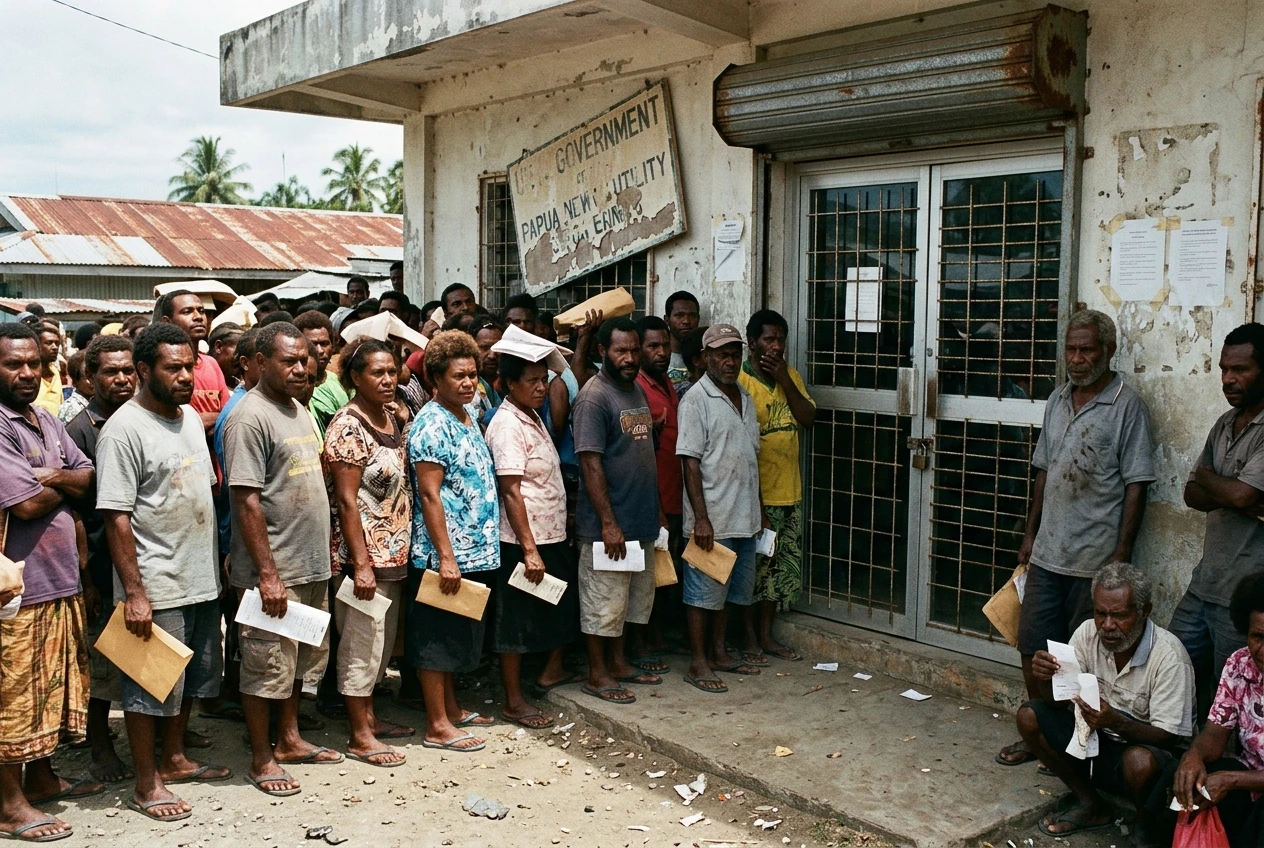
When two families in a Papua New Guinea village disagree over a garden boundary or a pig that wrecked a crop, the first people to hear about it are rarely police officers or magistrates in a distant town. They are elders, clan leaders and respected neighbours who know the families and the land. Traditional leadership in Papua New Guinea works at this level, in daily life, and it differs a great deal from one region to the next.
This article explains who leads in villages, how disputes are settled, where women hold authority, and where custom meets the state through village courts. It stays at village level on purpose. For the wider story, see the site’s pieces on national history and culture.
Why custom still matters in a country with hundreds of languages
Papua New Guinea has more than 800 languages, and most people live in rural areas. Many communities are a long way from a police station, a district court or a paved road. In those places, the process people know and trust is the one run by their own leaders.
The state has accepted this. The Constitution and the Underlying Law Act 2000 treat custom as part of the country’s law, so long as it does not conflict with the Constitution or an Act of Parliament. Custom is therefore a recognised source of rules, and local leaders are not simply filling a gap the government has left.
The word “custom” covers a great deal of variety, though. A Highlands clan, a Sepik river village, a Trobriand community and a Bougainville hamlet differ in how they trace descent, choose leaders and settle quarrels. Treating them as one “PNG tradition” gets almost every detail wrong.
Who leads a village: big men, clan elders, chiefs and why it differs by region
Many Highlands societies, such as the Melpa around Mount Hagen and the Enga, are known for the big man (bikman in Tok Pisin). A big man’s status is earned, not inherited. He builds it by organising exchanges, helping relatives with bride price and compensation payments, speaking persuasively in public, and being generous enough that others owe him loyalty. Exchange systems like the Moka in the Hagen area and the Tee in Enga are the arenas where this standing is built.
A big man’s authority depends on his followers. If his generosity fails or his judgement is poor, people stop listening. A big man issues no orders. He persuades, and his influence lasts only as long as his reputation does.
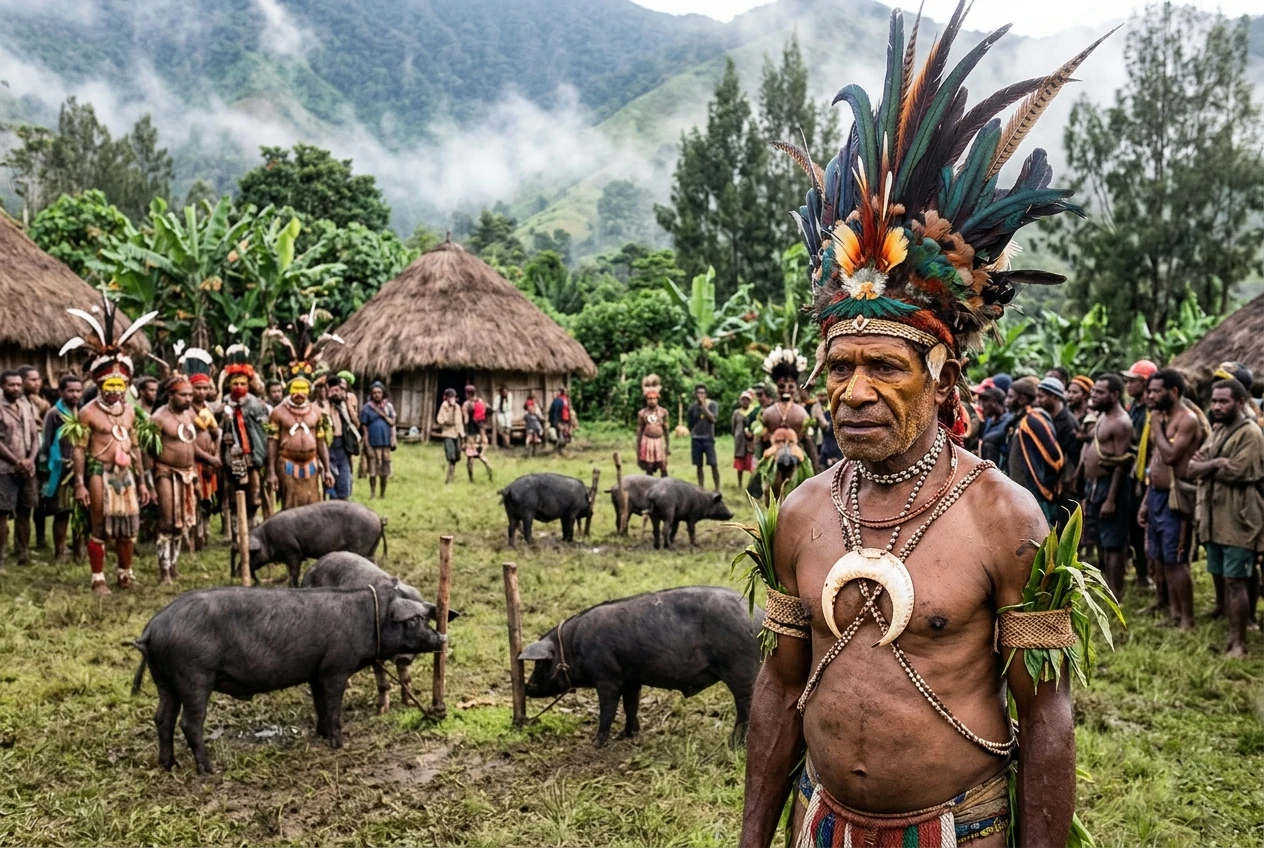
Other regions work differently:
- Trobriand Islands (Milne Bay): Rank is hereditary and passes through matrimonial clans and subclans, so chiefly status is inherited through the mother’s line.
- Sepik: Senior men who hold ritual knowledge, such as clan histories, names and the lore tied to ceremonial houses, carry much of the authority. Initiation and age matter.
- East New Britain (Tolai): Descent is matrimonial, clans are central, and traditional leaders work alongside the shell money (tabu) that still plays a part in ceremonies and payments.
- Bougainville: Many communities are matrimonial, and chiefs and clan leaders hold roles tied closely to land.
Layered over all of this are the leaders of the modern system: ward councillors elected through local-level government, church leaders, and village court officials. In practice a village may turn to a clan elder for one problem, the pastor for another and the councillor for a third. Which person carries weight depends on the issue and the people involved.
Where women hold authority, and where they are left out
Women’s authority varies sharply by region, and it is easy to describe wrongly.
In matrimonial societies, such as much of Bougainville, parts of Milne Bay and the Tolai area, land and clan membership pass through women. Senior women in these societies can have real say over who uses land and how it is passed on, even where men do most of the public speaking. In Bougainville, women also played a prominent part in the peace process that followed the conflict of the 1990s, and the Autonomous Bougainville Government reserves seats for women in its House of Representatives.
In many patrilineal Highlands communities, women’s influence runs through other channels. Women raise pigs, which are central to exchange and compensation, and their work and their family ties help build a man’s reputation. Their influence on decisions often happens in private conversation, with the husband, brother or son then speaking publicly.
There are real exclusions too. In many places women are not allowed to speak at formal hearings, are kept out of men’s houses and ceremonial spaces, or have weaker claims to land after marriage. Women’s groups, churches and women village court magistrates have been pressing for a larger role, and progress varies widely between districts. A fair account of customary governance includes both the authority women hold and the places where they are shut out.
How a village settles a dispute: mediation, compensation and restoring relationships
A customary hearing differs from a courtroom trial. The main aim is to restore relationships so the dispute does not grow into something worse, not to name a winner and a loser. People who will keep living, farming and marrying near each other cannot afford a ruling that leaves a permanent grudge.
Procedures differ from place to place, but a typical case runs like this:
- The complaint is raised with a clan elder, big man or other respected person, often by the injured family.
- A meeting is called, usually in the open, where both sides and their relatives can speak. Many people are allowed their say, and the discussion can take hours or days.
- Leaders question and mediate. They look at what happened, but also at the history between the families, who is related to whom, and what each side needs in order to move on.
- A settlement is agreed. This often includes an apology and compensation, paid in pigs, shell valuables, garden produce or cash, depending on the region and the seriousness of the harm.
- The settlement is sealed publicly, often with a shared meal or a ceremony, so that everyone knows the matter is closed.
Compensation has a practical purpose. Where an injury or a death is not answered, the injured group may feel obliged to take payback (peibek), which can begin a cycle of retaliation between groups. A recognised payment, accepted in front of the community, gives both sides a way to stop.
This system has limits. For serious crimes such as murder or rape, compensation does not replace the criminal law, and the state may become involved. How the two systems meet in a particular case is often decided locally and can be contested.
Village courts: where custom meets the state
The village courts are the formal link between custom and the state. They were introduced in the 1970s, around independence, and are now governed by the Village Courts Act 1989. The idea was to give communities a recognised forum that works close to home, in a language people understand, using local custom.
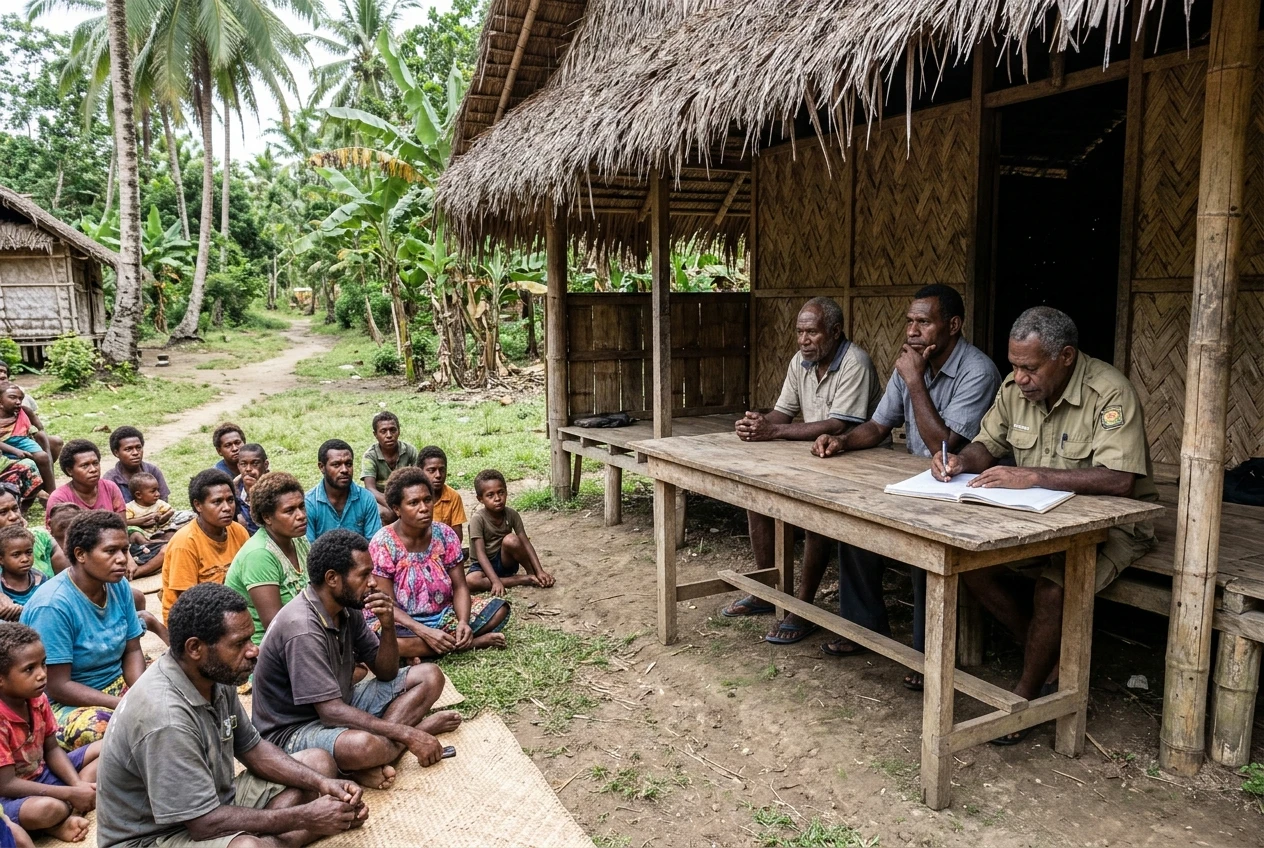
Village court magistrates are drawn from the community they serve and are approved and trained under the system. They normally hear matters such as land use disagreements, minor assaults, family and marriage disputes and damage to property. They can mediate, apply local custom, and order compensation or other penalties within the limits of the law. They cannot deal with serious offences, and their decisions can be appealed to the District Court.
Village courts work best when the magistrates are respected by their community, and they are often the first formal body a person meets. Village courts are also commonly reported to be under-resourced, with limited funding and support, and the quality of their work varies from district to district. The courts are widely valued, but they cannot be treated as a perfect system.
Customary land: the issue that touches nearly every dispute
Most land in Papua New Guinea, commonly put at around 97 percent, is held under customary ownership, not by individuals with titles. Land belongs to clans and other kin groups, and a person’s rights come from membership of the group, usually through descent. The rights are often layered: one person may have the right to garden a plot, another to harvest sago or trees from it, and the group as a whole holds ultimate ownership.
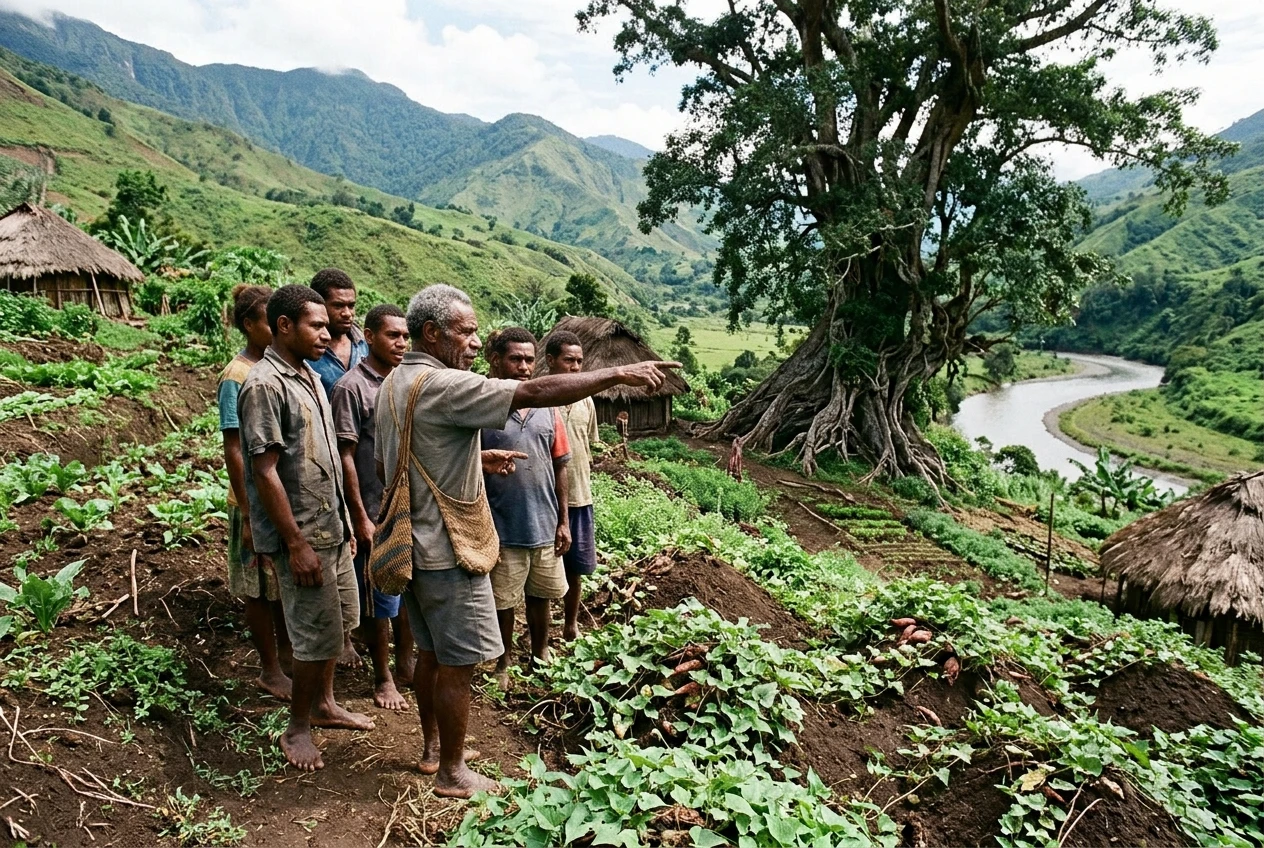
Boundaries are usually recorded in memory and story rather than on paper. A river bend, a large tree, a ridge or a stone can mark a boundary, and the history of who cleared the land, who fought for it and who allowed others to use it is passed down by elders. When memories differ, or when a younger generation sees the history differently, a dispute follows.
Land is behind many quarrels over gardens, inheritance, marriage and settlement. It becomes more tense when money enters. Mining, logging and agriculture projects raise questions about who the true owners are and who should receive royalties or compensation. The Land Groups Incorporation Act 1974 allows customary groups to register as incorporated land groups, which gives them a legal identity, but who counts as a member can itself be disputed. For more on how resource projects shape these questions, see the site’s guide to how mining shapes PNG.
When custom is under strain: youth, money, migration and mining
Customary governance has always adapted, and today it faces several pressures.
Money. Royalties, compensation payments and wages can shift influence away from leaders who earned it through exchange and service toward people who control cash. Disputes over who speaks for a clan, and who receives and shares payments, are now common.
Youth. Many young people have more schooling than their elders, can use phones and social media, and have seen town life. Some respect elders’ authority; others challenge it, especially when they feel excluded from decisions about land and money.
Migration. People move to towns and cities for work and school. In urban settlements, wantok networks and clan leaders still help settle problems, but the leaders may not have the standing they would have in the home village, and mixed communities have no shared rules.
Mining and resource projects. Large projects bring jobs, royalties and also arguments over who the owners are and how benefits are shared. Disputes can divide clans and villages that previously worked together.
Weapons. In parts of the Highlands, modern firearms have made inter group fights deadlier than they were with traditional weapons, and elders say that makes it harder to bring the fighting to an end through customary means.
None of this means custom is finished. In many places leaders, village courts, churches and women’s groups are working together to adapt it, and settlements still end with a shared meal, a handshake and a payment.
What readers can ask elders and local officials to learn more, with respect
Students, teachers and researchers who want to learn more should start by asking permission. Customary knowledge often belongs to particular families or clans, and some of it is sacred or restricted. An elder may be glad to explain a process but not to share a story that belongs to another group.
Some respectful questions to begin with:
- Who in this community settles disputes, and how are they chosen?
- Does the process differ depending on whether the dispute is about land, marriage or an injury?
- What role do women, churches and the ward councillor play?
- When does a case go to the village court, and when does it stay with the elders?
- How have these practices changed in your lifetime?
Good practice includes asking before you record or photograph anyone, naming the person and community you learned from, and checking with them that you have described it correctly. A village court official or the ward councillor can also explain how local procedures connect with the formal system. Treat what you hear as the account of one community, not a rule for all of Papua New Guinea.
Keep exploring
To place village governance in context, read the Papua New Guinea history timeline, use the provinces map to see how regions differ, and look at the cultural festivals where many of these traditions are on public display.
If you know how your own village settles disputes, we would like to hear it. Share your verified story through the contact page, and tell us the community, the region and who gave you the account, so that we can represent it accurately.