If you ask Papua New Guineans what traditional food means, the answer depends on where the person grew up. A family on the Sepik floodplain, a family in the Wahgi valley and a family on a Milne Bay island each describe a different table. Papua New Guinea traditional food follows the land, and in a country with swamps, mountain valleys, coral coasts and small islands, that produces very different daily meals.
This article goes region by region and looks at ordinary food rather than ceremony. For the festival side of food, see our piece on cultural festivals in Papua New Guinea.
Why there is no single PNG cuisine
Papua New Guinea has hundreds of languages and a wide range of environments, from mangrove swamps at sea level to gardens high in the mountains. People feed themselves from whatever grows well where they live, so the staple changes from place to place. A list of national dishes would flatten that variety, and many of the dishes on it would be unknown a few valleys away.
Three staples organise most of the picture:
- Sago, the starch of the sago palm, in swampy lowland areas.
- Kaukau (sweet potato) in the Highlands, alongside other garden crops.
- Taro, yam, banana and coconut on the coasts and islands, eaten with fish.
These are broad patterns, and most communities mix them. Highlands families also grow taro and bananas, and coastal families keep gardens. Trade, marriage and migration have carried foods across regions for a long time. If you want to place each food on the ground as you read, the provinces map shows how the country divides into regions.
Sago country: the swampy lowlands and the staple that grows wild
Sago palms grow in wet, swampy ground, and large stands of them occur in parts of the Sepik, the Gulf and Western provinces. In some places the palms grow wild and in others people tend them, but either way the starch is stored inside the trunk, ready to be harvested without planting a field.
How sago is made
Making sago is a skilled job done in stages:
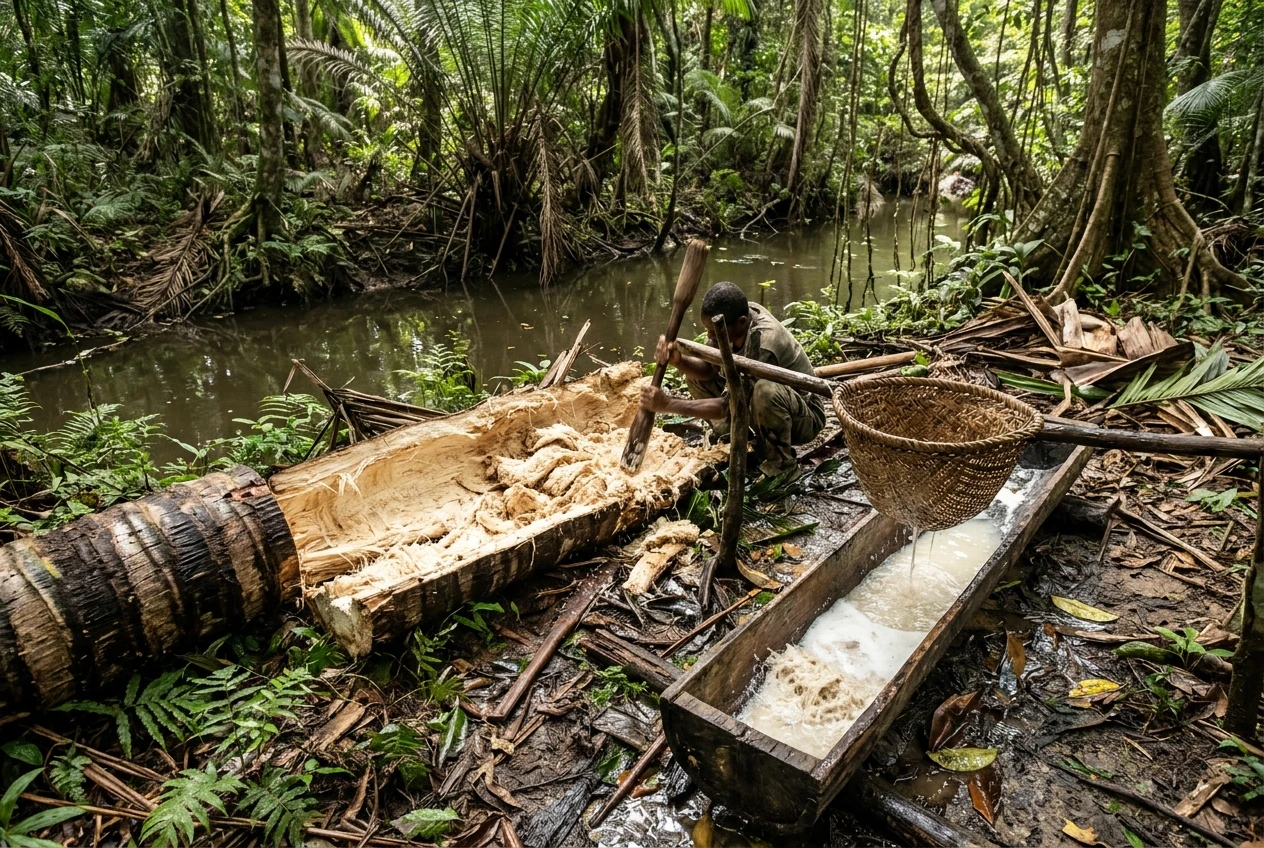
- A mature palm is felled and the bark is cut away to expose the pith.
- The pith is pounded or scraped into fibrous crumbs.
- The crumbs are washed with water through a strainer, often made from palm material, into a trough or container.
- The starch settles to the bottom and the water is poured off.
- The wet starch is cooked, or dried and stored for later.
Who does which task varies from community to community, and so does the equipment. What stays constant is that one palm yields a large amount of starch for a household, and the work is often shared among relatives.
How sago is eaten
Cooked sago can be a thick, sticky jelly, a pancake baked on hot stones or clay, or a block wrapped in leaves and baked over a fire. It tastes mild, so the meal is built around what goes with it: fish from the river, greens from the garden, or game from the bush.
Sago grubs are also eaten in lowland areas. They are the larvae that live in rotting sago palm trunks, and they are valued as a source of fat and protein. A visitor offered them is being offered something good, and a polite taste is received well.
Kaukau and the Highlands: gardens, pigs and daily food
The Highlands have cool weather, rich volcanic soil and valleys that have supported dense populations for a long time. The Kuk Early Agricultural Site near Mount Hagen is a World Heritage Site because it shows how long people have been farming and draining land in that area.
Today kaukau is the everyday staple for many Highlands families. Sweet potato came to New Guinea from outside the region, and researchers still discuss when it arrived. It grows well at altitude and gives dependable harvests, and its vines and tubers also feed pigs.
The garden as the centre of daily life
A Highlands garden usually grows several crops at once. A typical plot might hold:
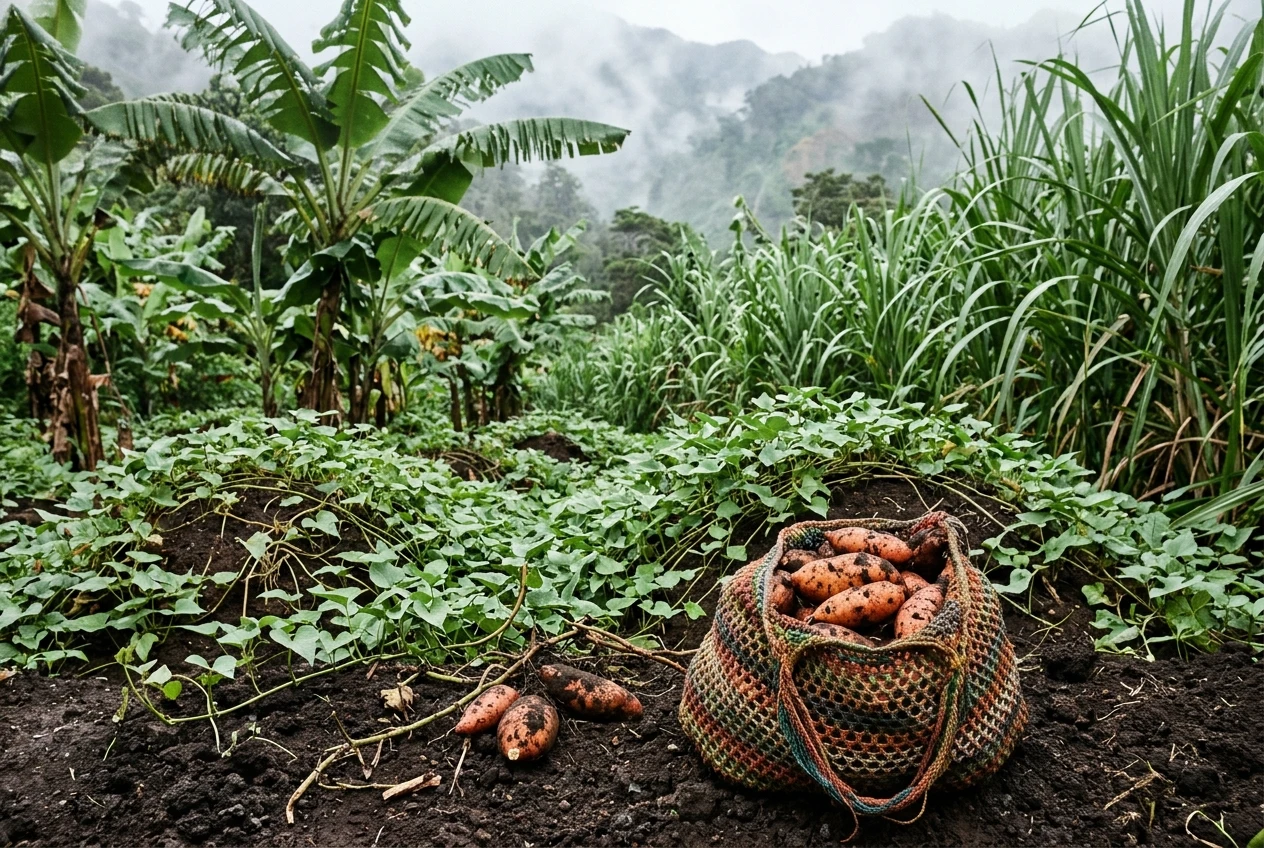
- Kaukau, the main starch, often planted in raised mounds.
- Taro and bananas.
- Sugarcane and pitpit, a cane-like plant whose shoots are cooked and eaten.
- Greens such as aibika, whose leaves are boiled or steamed.
- Beans, corn and cucumber in many areas.
Gardens are planted, weeded and harvested on a rotation, so there is food most of the year. In many Highlands communities women do much of the daily garden work, though practice differs between groups.
Pigs and kaukau
Pigs and kaukau are closely linked. Households raise pigs on sweet potato, and the animals are central to wealth, exchange and obligation between families. Pork is not an everyday meal in most households. It is saved for larger occasions, which is why the daily plate is mostly kaukau and greens, and the pig appears at gatherings and exchanges.
Many Highlands families also grow coffee as a cash crop on land close to their food gardens, so a household can eat from the same land that pays for school fees and store goods.
Coasts and islands: fish, coconut, taro and yam
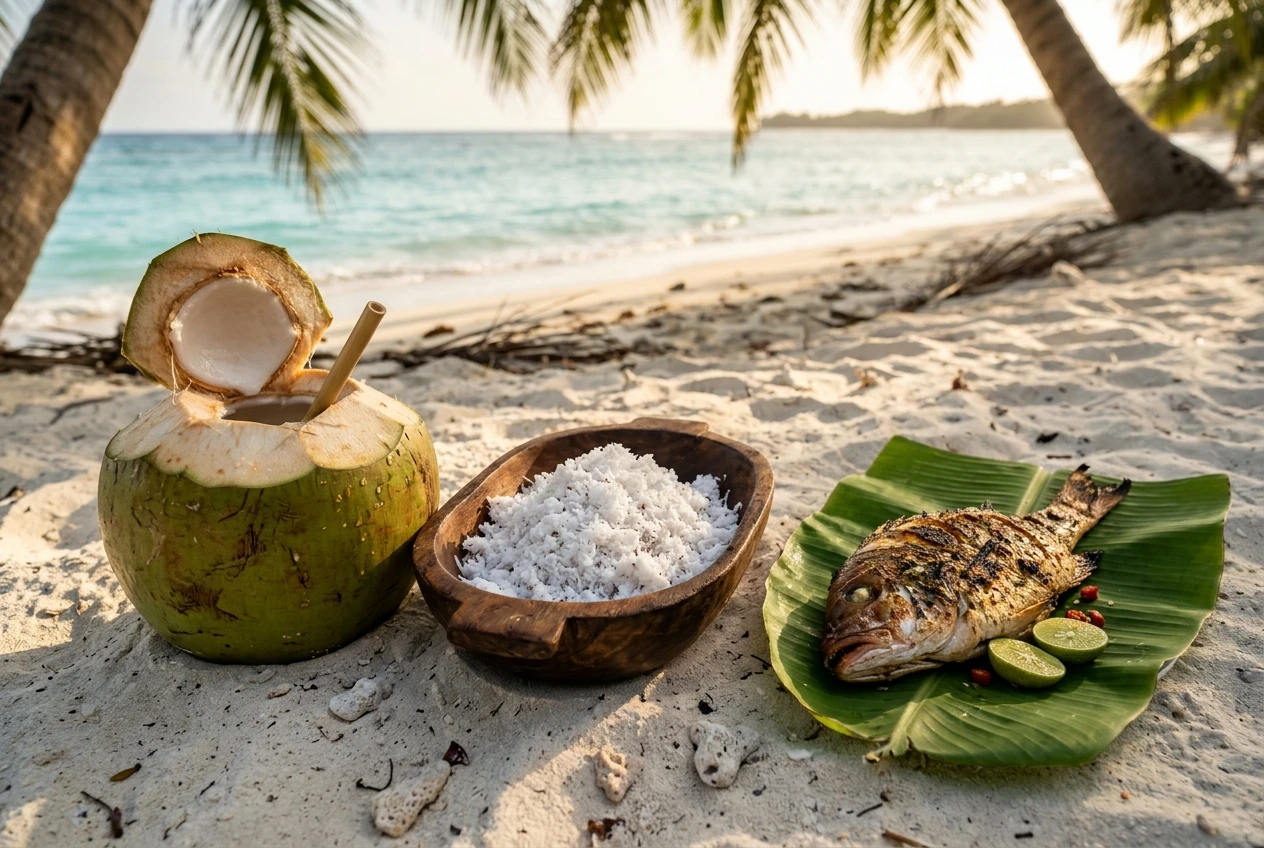
PNG’s long coastline and many islands give coastal people a diet built on the sea. Fish are caught with nets, lines, spears and traps, depending on the place, and shellfish and crabs are gathered from reefs and mangroves. Fresh fish is often grilled over a fire or cooked in coconut milk.
Coconut in the kitchen
Coconut is the most useful plant on the coast. The young drinking nut, called kulau in Tok Pisin, gives a safe, sweet drink. The mature flesh is grated and squeezed to make coconut cream, which goes into fish dishes, root crops and greens. The oil, the husk and the fronds are used as well, so one palm supplies food, fuel and building material.
Root crops and their place
Taro and yam are the main starches in many island communities. In parts of Milne Bay, including the Trobriand Islands, yams carry great cultural weight. Growing a good yam crop earns respect, and the harvest involves storage houses and exchange between families. Bananas, breadfruit and cassava are also eaten on the coast, and some communities combine these with sago.
Coastal meals are often simple. A typical one is boiled or baked taro or banana with fish and coconut cream, plus greens when available.
Mumu explained: how an earth oven works and who gathers around it
Mumu is the Tok Pisin word for an earth oven. It is a cooking method used in many parts of Papua New Guinea, rather than a single dish, and what goes into it depends on the region. In the Highlands it might be pork, kaukau and greens. On the coast it might be fish, banana and taro. Names and details change from one language group to the next.
How a mumu is built
The basic method follows the same steps almost everywhere:
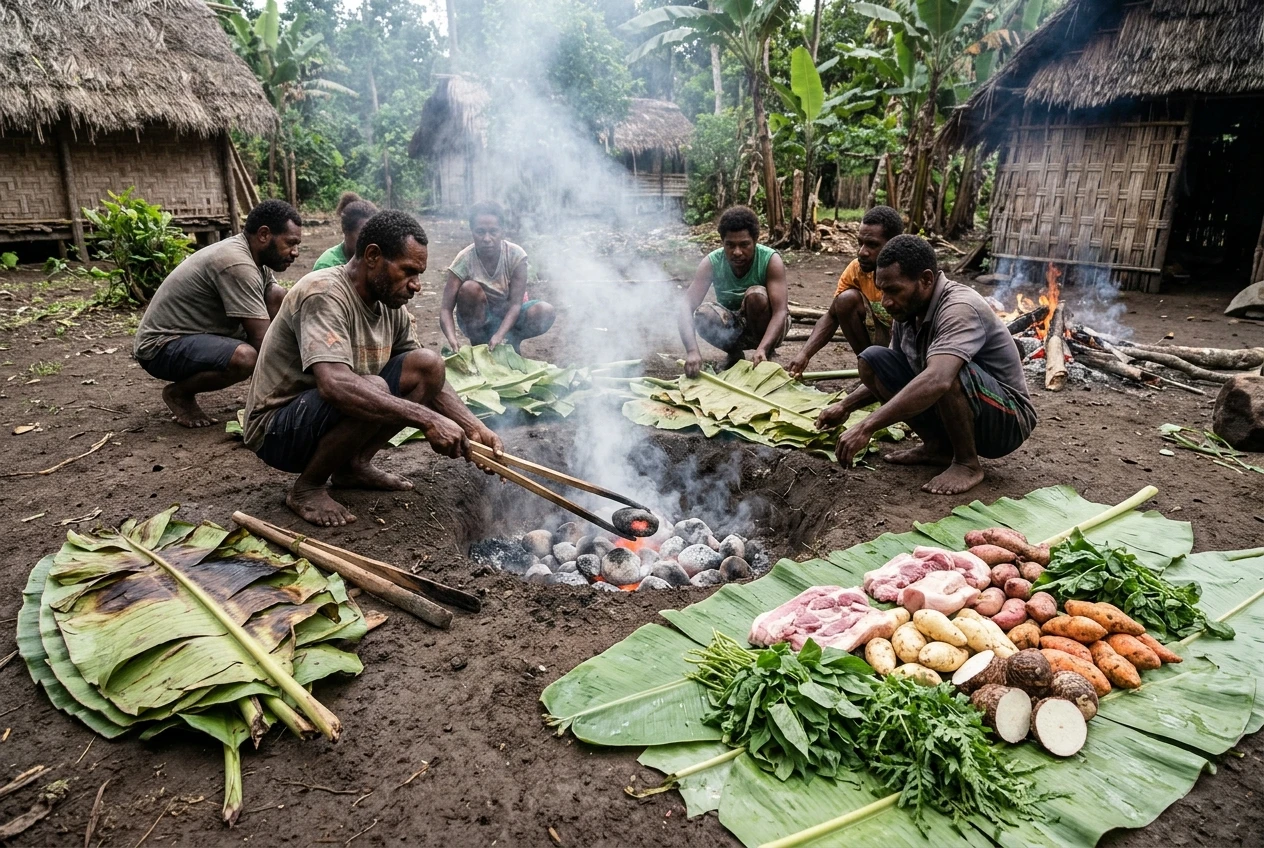
- A pit is dug and a fire is built in it, or on top of it, with stones set in the flames.
- When the stones are very hot, they are lifted out and some are set in the base of the pit.
- Leaves, usually banana or similar, are laid over the stones.
- Food is layered in: usually the tougher items, such as meat or large tubers, first, then softer vegetables and greens.
- More hot stones and more leaves are put on top, and in many places a little water is added to make steam.
- The whole pit is covered with leaves and earth and left to cook for hours.
The food steams slowly in its own juices and takes on the smell of the leaves. Opening a mumu is done carefully, since the stones are still hot and the steam can scald.
Who gathers around it
A mumu feeds many people at once, so it is usually a communal job. Different people dig, heat stones, prepare food, collect leaves and tend the pit. That shared effort is part of the reason a mumu usually marks something: a visit, a family gathering, a church event or a community day. The cook, the food and the guests are all part of one event.
Food and occasion: what is cooked for feasts, weddings and community events
Everyday food and occasion food differ mostly in quantity and in the kinds of food. Meat, especially pork, and the best of the garden’s produce appear when many people are being fed. The details belong to each community, so what follows is a general pattern and not a rule for everyone.
- Feasts and exchanges: Large amounts of food are cooked and shared, often in a mumu. The scale shows the host’s standing and the strength of their relationships.
- Weddings and bride price events: In many communities, food and pigs, or other valued goods, are part of what passes between families. What is given and in what amounts differs from place to place.
- Community and church events: A shared meal, often cooked in an earth oven, brings people together. Families contribute from their gardens.
- Mourning and remembrance: Many communities feed those who come to pay respects. Customs differ widely, and outsiders should follow local guidance.
Festivals, with their dance and display, show another side of this. The festival article linked above covers that, and the food at those events draws on the same regional foods described here.
Eating traditional food today: in town, overseas and as a visitor
In town
Town markets in places like Goroka, Mount Hagen, Lae and Port Moresby sell kaukau, bananas, taro, greens and coconuts, and many of these come from nearby villages and gardens. Urban households also eat rice and tinned fish, which are widely available and easy to store. So a town meal is often a mix, with traditional crops alongside store food.
Overseas
Papua New Guineans abroad often look for the foods of home, and some are easier to find than others. Sweet potato, taro, yam, bananas and coconut products can often be found in shops serving Pacific, Asian or African communities, though they may differ in variety from the ones grown at home. Sago and some of the garden greens are harder to find. Cooking methods travel more easily than ingredients, and families overseas sometimes adapt an oven or a covered pot to the idea of a mumu.
As a visitor
If you are invited to share a meal in a village, a few habits help:
- Accept what is offered, and eat what you can, since food is a form of hospitality.
- Ask before photographing a mumu being prepared or the people around it.
- Ask a host before taking food from a garden or a tree, since land and trees belong to someone.
- If you are staying, offering to help, or contributing something agreed with your host, is appreciated.
For wider planning, our travel tips for Papua New Guinea cover practical points before a trip.
Share your family’s food story
Tell us how your family or village prepares mumu, sago or kaukau. Send your story and photos through the Contact page and it may feature in a future PAPUANIUGINI.ORG article on food and culture.